TETRA TECH
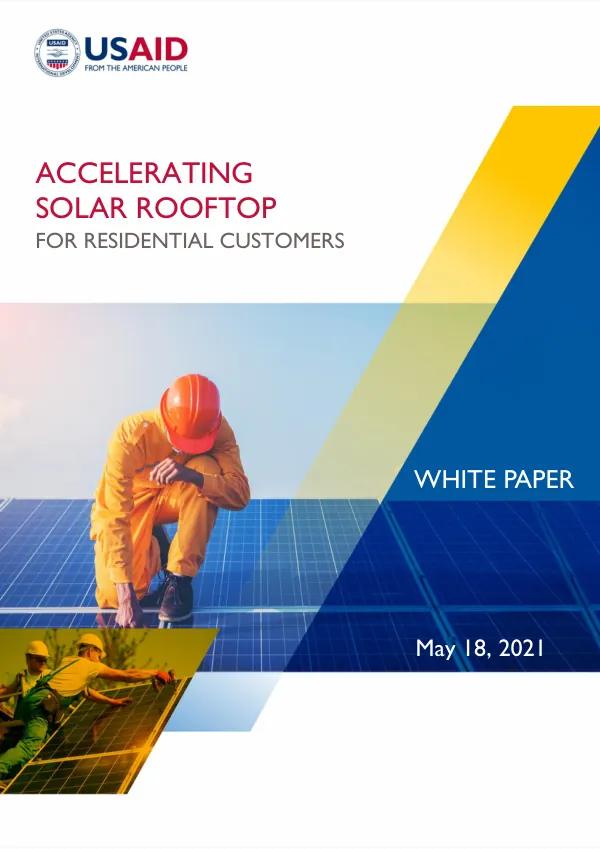
Accelerating Solar Rooftop for Residential Customers
Accelerating Solar Rooftop in Domestic Category is a white paper prepared for the US Agency for International Development (USAID) by Tetra Tech.
2021 · 43 pages
Sign in to readA free account is required to download.
Abstract
The document aims to accelerate the adoption of solar rooftop systems for residential customers in India. The initiative began in 2018 with funding from USAID's Food Security Program, but the current document focuses on the solar rooftop sector. The document highlights the challenges faced by Distribution Companies (DISCOMs) in implementing solar rooftop programs. DISCOMs perceive the solar rooftop sector as a threat to their business model, as it reduces their revenue from electricity sales. However, the document argues that DISCOMs can benefit from solar rooftop programs by designing appropriate business models. The document proposes a new business model, called Super RESCO (Renewable Energy Service Company), which addresses the challenges faced by DISCOMs. The Super RESCO model involves a third-party-owned business model, where a private company owns and operates the solar rooftop system, and the DISCOM acts as a facilitator, mediator, and investor. The model aims to reduce the financial and regulatory risks associated with solar rooftop programs. The document presents a financial and economic analysis of the Super RESCO model. The analysis shows that the model can generate significant benefits for stakeholders, including DISCOMs, customers, and the environment. The document also presents a methodology for implementing the Super RESCO model, including identification of the location, tender design, customer involvement, capacity-building of DISCOM field units, and monitoring of the program. The document highlights the importance of bundling the distribution franchise model with the Super RESCO model to address the challenges faced by DISCOMs. The bundled model can help DISCOMs to reduce their financial and regulatory risks, while also promoting the adoption of solar rooftop systems. The document presents case studies of states that have successfully rolled out solar PV rooftop programs. The case studies highlight the key lessons learned from these programs, including the importance of designing appropriate business models, reducing financial and regulatory risks, and promoting customer involvement. The document concludes by presenting key recommendations for the implementation of the Super RESCO model. The recommendations include the need for DISCOMs to design appropriate business models, reduce financial and regulatory risks, and promote customer involvement. The document also highlights the importance of bundling the distribution franchise model with the Super RESCO model to address the challenges faced by DISCOMs. The document presents a comprehensive analysis of the solar rooftop sector in India, highlighting the challenges faced by DISCOMs and the benefits of the Super RESCO model. The document provides a roadmap for the implementation of the Super RESCO model, including the identification of the location, tender design, customer involvement, capacity-building of DISCOM field units, and monitoring of the program. The document highlights the importance of promoting the adoption of solar rooftop systems in India, which can help to reduce the country's dependence on fossil fuels, mitigate climate change, and promote energy security. The document presents a vision for a sustainable energy future in India, where solar rooftop systems are a key component of the country's energy mix.