TETRA TECH
Case Study of Jharkhand
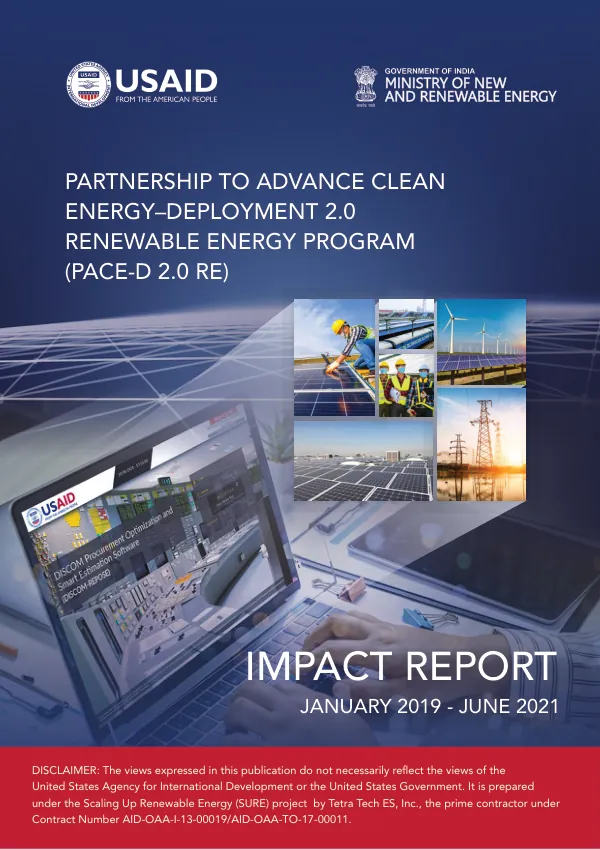
The Partnership to Advance Clean Energy – Deployment (PACE-D 2.0 RE) is a flagship program of the United States Agency for International Development (USAID) in collaboration with India's Ministry of New and Renewable Energy.
2021 · 4 pages
Sign in to readA free account is required to download.
Abstract
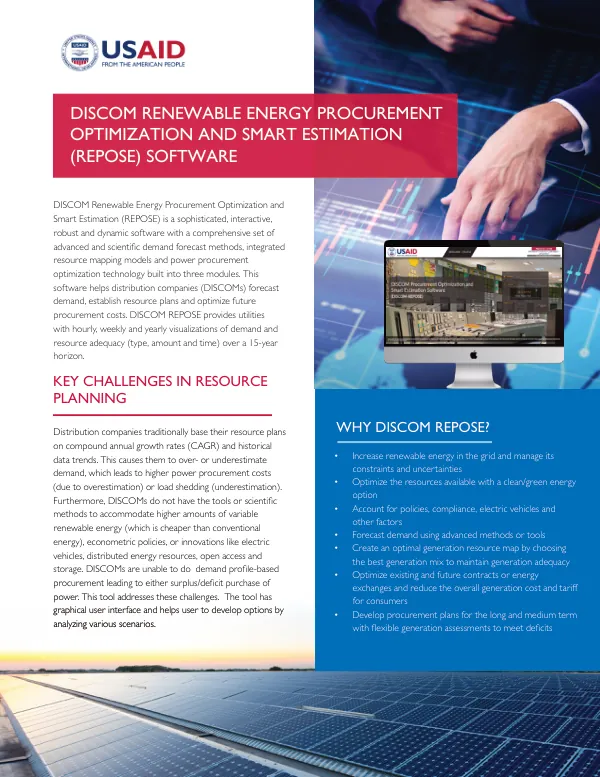
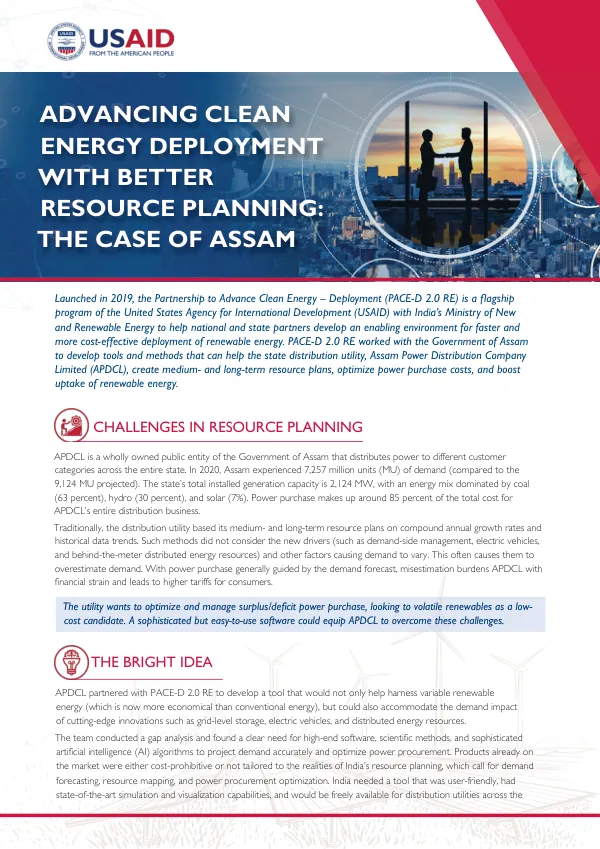
The program aims to develop an enabling environment for faster and more cost-effective deployment of renewable energy in India. PACE-D 2.0 RE worked with the Government of Jharkhand to develop tools and methods that can help the state distribution utility, Jharkhand Bijli Vitran Nigam Limited (JBVNL), create medium- and long-term resource plans, optimize power purchase costs, and boost uptake of renewable energy. JBVNL is a public entity of the Government of Jharkhand that distributes power to different customer categories across the entire state. In 2020, Jharkhand experienced 9,365 million units (MU) of demand, compared to the 12,214 MU projected. The state's total installed generation capacity is 21,944 MW, with an energy mix dominated by coal (65 percent), hydro (18 percent), wind (15 percent), and solar (2 percent). Power purchase makes up around 77–80 percent of the total cost of JBVNL's entire distribution business. Traditionally, the distribution utility based its medium- and long-term resource plans on compound annual growth rates and historical data trends. However, such methods did not consider the new drivers (such as demand-side management, electric vehicles, and behind-the-meter distributed energy resources) and other factors causing demand to vary. This often causes them to overestimate demand, leading to financial strain and higher tariffs for consumers. The utility wants to optimize and manage surplus/deficit power purchase, looking to volatile renewables as a low-cost candidate. JBVNL partnered with PACE-D 2.0 RE to develop a tool that would not only help harness variable renewable energy but also accommodate the demand impact of cutting-edge innovations such as grid-level storage, electric vehicles, and distributed energy resources. The team conducted a gap analysis and found a clear need for high-end software, scientific methods, and sophisticated artificial intelligence (AI) algorithms to project demand accurately and optimize power procurement. The software, DISCOM REPOSE, is a sophisticated, interactive, robust, and dynamic tool with a comprehensive set of advanced methods for forecasting demand, integrated resource mapping models, and power procurement optimization technology built into three modules. DISCOM REPOSE provides hourly, weekly, and yearly visualizations of demand and resource adequacy over a ten-year horizon. The tool is flexible, allowing utilities to use any of the modules on its own or all three for integrated planning. Using DISCOM REPOSE, JBVNL is now equipped with AI-driven statistical and scientific methods to estimate demand in an uncertain environment. The demand forecasting module simulates each consumer category by applying the best-fitting statistical and scientific methods, including trend analysis, compound annual growth rate, econometrics, ARIMA, ANN, and partial end use. The software selects the best fit after considering future year growth, R2 (the statistical index), and standard error. The resource mapping module optimizes generation commitments after considering each resource's technical and commercial constraints. It can balance a variety of types of resources, including thermal, hydropower, and variable renewables such as wind and solar. By using Monte Carlo simulation techniques and mixed-integer linear programming algorithms, DISCOM REPOSE's resource mapping module helps JBVNL plan generation schedules and dispatches at hourly and weekly intervals. The power procurement optimization module helps JBVNL planners study the seasonality of demand and take weather conditions into account when shaping generation strategies. Spanning several-year periods, this resource mapping also helps the team factor in when resources will retire and predict what new resources will be needed to balance the forecasted demand. The REPOSE tool is helping JBVNL cut its power purchase cost by approximately 10 percent by suggesting options through which utility can better restructure their existing contracts. JBVNL has surplus energy and reserves with existing built-up capacity, so it has to pay fixed charges for stranded capacity. Moreover, based on that capacity and future contracts, procurement is likely to cost around $8.6 billion over the next ten years. To use the stranded capacity and reduce costs, JBVNL can consider avenues such as adding a new customer category (electric vehicles), supplying power to other states, and postponing future contracts. DISCOM REPOSE generated several power plan options to better use resources and found that JBVNL's best path is to restructure upcoming thermal units' contracts by postponing their commissioning dates.