TETRA TECH ESI, INC.
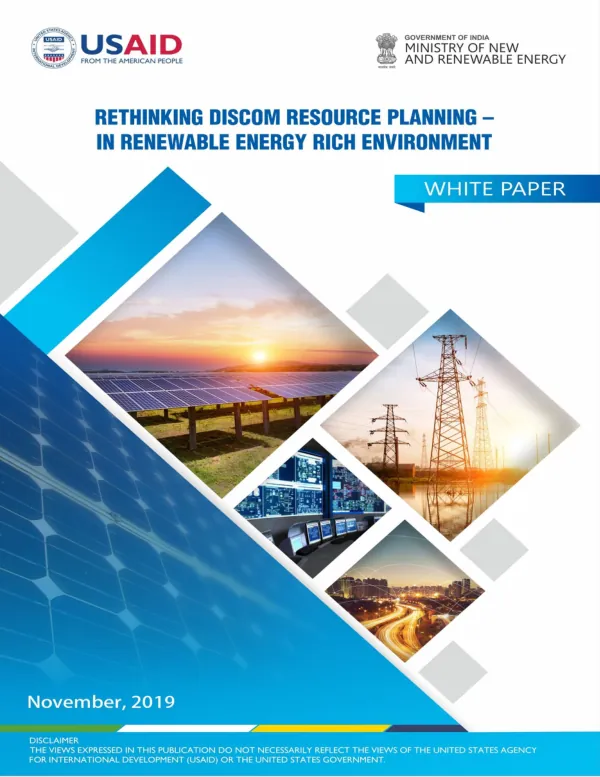
Rethinking DISCOM Resource Planning for a Renewable Energy Rich Environment
Renewable energy technologies are poised to become a mainstream resource in the Indian power sector.
77 pages
Sign in to readA free account is required to download.
Abstract
Significant capacity addition, cost reduction, and market maturity have been achieved through policies such as feed-in tariffs, tax incentives, and renewable purchase obligation (RPO). However, India requires a faster pace of renewable energy capacity addition to achieve its national target of 175 GW and potentially expand it multiple folds in the next decade. States and Discoms will play a crucial role in helping India achieve its renewable energy goal. Discoms, responsible for meeting the majority of RPO targets, are reaching their absorptive capacity to add more renewables due to surplus power situations, financial losses, limited capacity to plan and procure RE in a cost-effective manner, and grid management issues. The lack of a systematic and holistic planning approach and institutional capacities is exacerbated by distributed generation, electric vehicles, storage, and other "disruptive" technologies. This necessitates a rethink of planning approaches adopted for a fossil-fuel dominated scenario to RE-rich scenarios to plan and develop the best RE resources to meet future energy demand. The Partnership to Advance Clean Energy Deployment (PACE-D 2.0 RE) program, implemented by the U.S. Agency for International Development (USAID) in partnership with the Ministry of New and Renewable Energy (MNRE), has initiated an assessment of current mid and long-term resource planning practices at the national and state level. This assessment aims to understand how to improve resource planning to include RE-specific attributes in demand forecasting, resource planning, and portfolio optimization, ensuring Discoms have robust plans to accelerate the deployment of renewable energy. The Indian power sector is undergoing a significant transformation, driven by the increasing adoption of renewable energy sources. The country's renewable energy target of 175 GW by 2022 is a testament to this shift. However, the Discoms, responsible for meeting the majority of RPO targets, are facing challenges in integrating renewable energy into their power purchase portfolios. The lack of a systematic and holistic planning approach and institutional capacities is exacerbating these challenges. The PACE-D 2.0 RE program has identified several key areas that need to be addressed to improve resource planning in India. These include the development of alternative resource portfolios, considering renewable energy resources, and managing risk and uncertainty. The program has also highlighted the importance of international best practices in resource planning, such as those adopted in the United States and Australia. In the United States, the demand forecasting process involves the use of advanced tools and techniques, such as machine learning and big data analytics. The development of alternative resource portfolios involves considering a range of renewable energy resources, including solar, wind, and hydroelectric power. Risk and uncertainty management is also a critical component of resource planning in the United States, with a focus on identifying and mitigating potential risks associated with renewable energy integration. In Australia, the Australian Energy Market Operator (AEMO) plays a critical role in resource planning, providing a range of services, including demand forecasting, resource planning, and risk management. The AEMO uses advanced tools and techniques, such as machine learning and big data analytics, to inform its resource planning decisions. The AEMO also works closely with Discoms and other stakeholders to ensure that resource planning decisions are aligned with the needs of the market. The PACE-D 2.0 RE program has identified several key recommendations for improving resource planning in India. These include the development of a systematic and holistic planning approach, the consideration of renewable energy resources in resource planning, and the use of advanced tools and techniques, such as machine learning and big data analytics. The program also recommends the establishment of a robust risk management framework to identify and mitigate potential risks associated with renewable energy integration. In conclusion, the Indian power sector is undergoing a significant transformation, driven by the increasing adoption of renewable energy sources. The Discoms, responsible for meeting the majority of RPO targets, are facing challenges in integrating renewable energy into their power purchase portfolios. The PACE-D 2.0 RE program has identified several key areas that need to be addressed to improve resource planning in India, including the development of alternative resource portfolios, considering renewable energy resources, and managing risk and uncertainty. The program has also highlighted the importance of international best practices in resource planning, such as those adopted in the United States and Australia.