USAID DEC
Accra Declaration on combatting illegal trade in Rosewoods, timber, and forest products in West Africa
Sign inFOOD AND AGRICULTURAL ORGANIZATION
Accra Declaration on combatting illegal trade in Rosewoods, timber, and forest products in West Africa
The Accra Declaration on Combating Illegal Trade in Rosewoods, Timber, and Forest Products in West Africa was adopted on July 31, 2019, in Accra, Ghana.
2019 · 4 pages
Sign in to readA free account is required to download.
Abstract
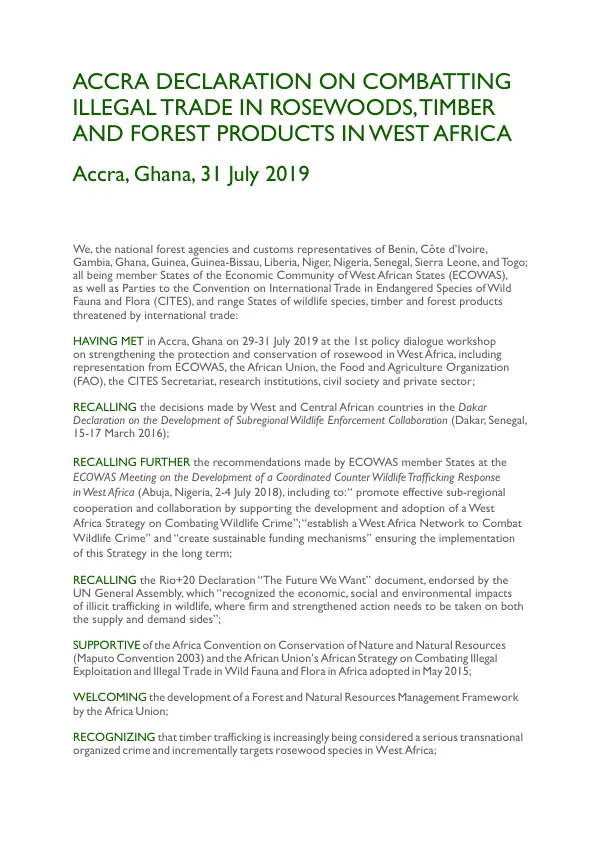
The declaration was signed by national forest agencies and customs representatives of 12 West African countries, including Benin, Côte d'Ivoire, Gambia, Ghana, Guinea, Guinea-Bissau, Liberia, Niger, Nigeria, Senegal, Sierra Leone, and Togo. The declaration was made in response to the alarming rate of rosewood tree species and forest receding in West Africa, as well as the concomitant explosion of trafficking in timber and forest products. The declaration recognized that timber trafficking is increasingly being considered a serious transnational organized crime, and that it targets rosewood species in West Africa. The declaration acknowledged the need to build synergy on mechanisms to curb illegal trade in timber and forest products between ECOWAS member States. It also recognized the importance of the development and implementation of the West Africa Strategy on Combating Wildlife Crime, the West Africa Network to Combat Wildlife Crime, and their associated funding mechanisms as regional actions directed towards curbing illegal trade in timber and forest products. The declaration made several recommendations to high-level decision-makers, including prioritizing and continuing to support the development and implementation of the West Africa Strategy on Combating Wildlife Crime, categorizing the fight against the illegal trade in timber and forest products as having the highest level of priority under the law, and deploying necessary security and armed forces to support front-line officers in their efforts to combat illegal logging and illegal trade in timber and forest products. The declaration also urged ECOWAS member States to promote cooperation among their national forest, customs, and other enforcement and security agencies in information and intelligence sharing related to illegal trade of timber and forest products across the region. It also encouraged financial and technical partners, donors, and all interested stakeholders to prioritize and continue supporting the development and implementation of the West Africa Strategy on Combating Wildlife Crime, scientific research and capacity building, and the development of resources facilitating the identification of timber in trade. The declaration was made possible by the generous support of the American People through the United States Agency for International Development (USAID). The contents of the declaration are the sole responsibility of its authors and do not necessarily reflect the views of USAID or the United States Government. The declaration emphasized the need for a coordinated counter-wildlife trafficking response in West Africa, including the establishment of a West Africa Network to Combat Wildlife Crime and the development of a West Africa Strategy on Combating Wildlife Crime. It also recognized the importance of strengthening the capacity of local communities to fight against illegal trade in timber and forest products and promoting the development of alternative livelihoods when appropriate. The declaration encouraged the African Union, the CITES community, development partners, United Nations agencies, international organizations, non-governmental organizations, the private sector, civil society, and media to prioritize support for the implementation of the recommendations of this Declaration whenever appropriate and by all means available.
Related documents