USAID DEC
ACDI/VOCA Helps Farmers Quadruple Revenues While Improving Export Competitiveness in EGYPT
Sign inACDI/VOCA
ACDI/VOCA Helps Farmers Quadruple Revenues While Improving Export Competitiveness in EGYPT
The Advanced Marketing and Agribusiness Logistics (AMAL) project in Egypt's Upper Egypt region focuses on improving the livelihoods of small farmers, particularly women, through technical assistance and training.
2016 · 2 pages
Sign in to readA free account is required to download.
Abstract
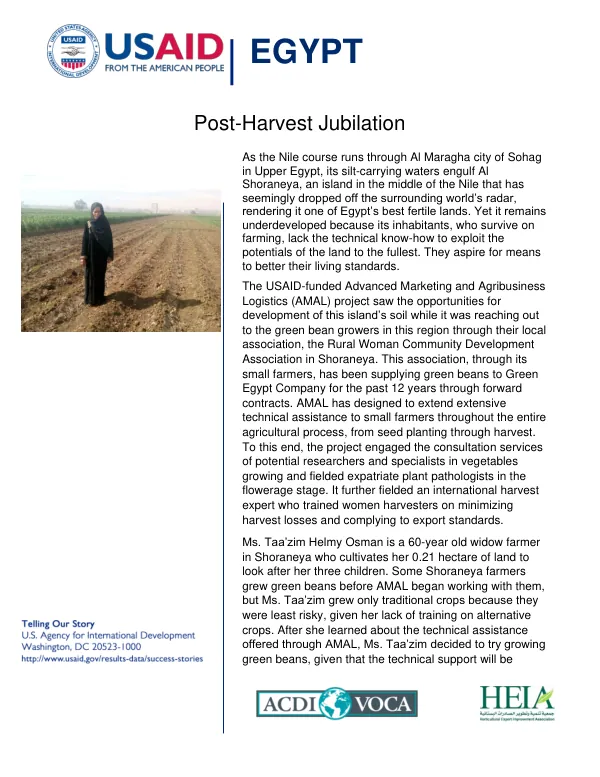
The project targets the island of Al Shoraneya, which is known for its fertile soil but remains underdeveloped due to a lack of technical expertise among its inhabitants. The USAID-funded project aims to enhance the island's agricultural productivity and competitiveness by providing extensive technical support to small farmers throughout the entire agricultural process. The project engages the services of researchers, specialists, and international experts in vegetables growing, including expatriate plant pathologists and a harvest expert. These experts provide training to farmers on best practices, such as minimizing harvest losses and complying with export standards. The project also focuses on improving the skills of women harvesters, who play a crucial role in the agricultural process. By providing technical assistance and training, the AMAL project seeks to increase the productivity and income of small farmers, particularly women, and improve their overall living standards. One of the success stories of the AMAL project is that of Ms. Taa'zim Helmy Osman, a 60-year-old widow farmer who cultivates 0.21 hectares of land to support her three children. Prior to the project, Ms. Taa'zim grew traditional crops due to her lack of training on alternative crops. However, after learning about the technical assistance offered through the AMAL project, she decided to try growing green beans, which have become a highly profitable crop for her. With the support of the project, Ms. Taa'zim was able to achieve a yield of 14.7 tons per hectare, significantly higher than the average yield in the region. The AMAL project's focus on technical assistance and training has enabled Ms. Taa'zim to increase her income and improve her living standards. She sold 100% of her green bean produce to Green Egypt Company and achieved a gross margin of $1680 per hectare. Ms. Taa'zim plans to use the money generated from her crop to cover her healthcare expenses and fund her younger son's education. The project's success in improving the livelihoods of small farmers like Ms. Taa'zim demonstrates its potential to make a positive impact on the lives of thousands of people in the region. The AMAL project's approach to improving agricultural productivity and competitiveness in the Upper Egypt region is centered on providing technical assistance and training to small farmers. By engaging the services of experts and providing training to farmers, the project seeks to increase the productivity and income of small farmers, particularly women, and improve their overall living standards. The project's success in improving the livelihoods of small farmers like Ms. Taa'zim highlights the importance of technical assistance and training in enhancing agricultural productivity and competitiveness in the region.
Related documents
Documents in this collection
 2009
2009USAID DEC
A PARTNERSHIP FOR PROSPERITY 2004 - 2009 Accomplishments
Open record 2018
2018USAID DEC