FRED HOLLOWS FOUNDATION
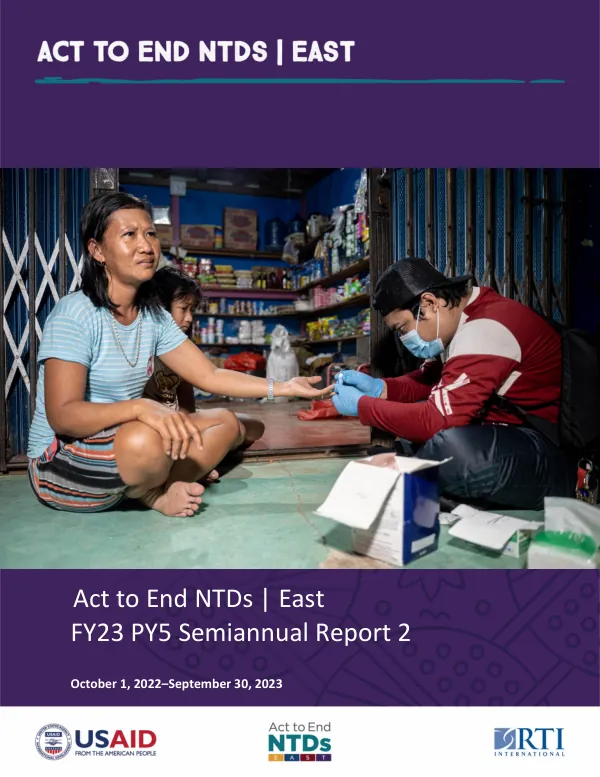
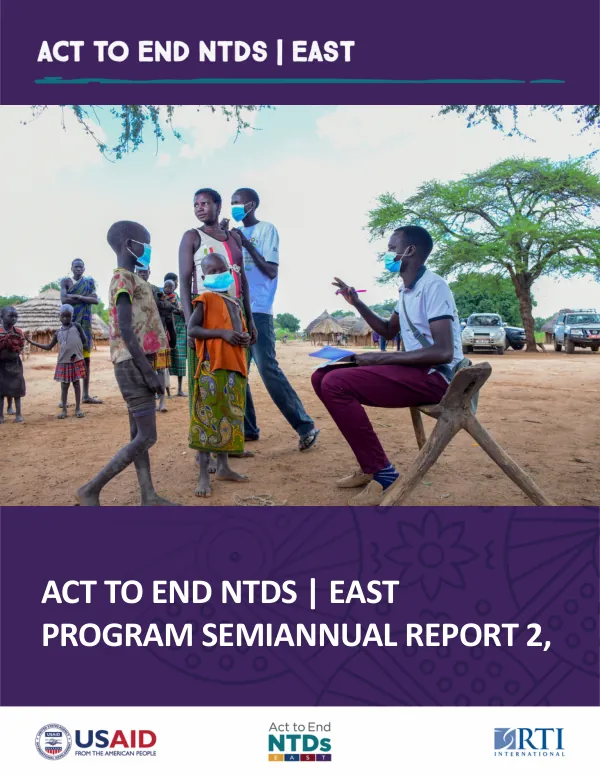
Act to End NTDs | East Program Semiannual Report 2, FY21
The Act to End Neglected Tropical Diseases (NTDs) | East program supports health ministries in the Eastern Africa region to reach World Health Organization goals for NTD control and elimination.
2021 · 61 pages
Sign in to readA free account is required to download.
Abstract
The program provides critical support to governments to create sustainable platforms for NTD services within robust and resilient health systems. The program is implemented by a consortium of partners, led by RTI International, and including The Carter Center; Fred Hollows Foundation; Light for the World; Results for Development (R4D); Save the Children; Sightsavers; and Women Influencing Health, Education, and Rule of Law (WI-HER). The program's fiscal year 2021 (FY21) work plan strategic roadmap focuses on three main results: elimination of lymphatic filariasis, trachoma, and onchocerciasis in the Americas and where feasible in Africa; sustainable national NTD programs; and ensuring continuous capacity to maintain and operate mass drug administration (MDA) and disease surveillance. The program's strategy involves supporting governments to optimize the use of NTD-related resources in their health and education systems, establishing national disease-specific action plans with targets based on Ministry of Health resources, and identifying community and facility platforms for delivery of sustainable deworming and morbidity management services. The program's result 1 focuses on elimination of lymphatic filariasis, trachoma, and onchocerciasis in the Americas and where feasible in Africa. The program's strategy involves ensuring that national disease-specific strategies/action plans are in place, obtaining and sustaining optimal program MDA coverage, meeting disease-specific criteria to stop MDA and conduct quality post-MDA surveillance, ensuring that dossiers are assembled and submitted, and closing out Act | East activities in the Democratic Republic of Congo. The program's result 2 focuses on sustainable national NTD programs, with a strategy that involves supporting governments to optimize the use of NTD-related resources in their health and education systems to achieve greatest impact and supporting the World Health Organization for the NTD Sustainability Framework for Action. The program's result 3 focuses on ensuring continuous capacity to maintain and operate MDA and disease surveillance. The program's strategy involves establishing national disease-specific action plans with targets based on Ministry of Health resources, identifying community and facility platforms for delivery of sustainable deworming and morbidity management services, and contributing to global policy decisions through participation in WHO global forums. The program's influencing the global agenda result involves contributing to global policy decisions through participation in WHO global forums, contributing to global learning and policy decisions through participation in global NTD forums, supporting leadership and collaboration for the management of NTD global medicines, and disseminating information on successes, challenges, and lessons learned from Act | East-supported countries. The program's communications result involves celebrating and promoting the impact and accomplishments of USAID's Act | East Program, facilitating learning by the Act | East Program to enable evidence-based programmatic adaptation, integrating gender into Act | East learning and adapting, and ensuring effective and efficient program staffing at the HQ and country levels. The program's program management result involves ensuring effective and efficient program staffing at the HQ and country levels, facilitating and promoting Act | East consortium partners' and RTI leadership coordination, and program reporting. The program's Act | East – USAID Partnership result involves maintaining continuous communication with USAID on all matters affecting program implementation, and the program's Act | East Partnership with Act to End NTDs | West result involves effective coordination with Act | West.
Related documents