USAID DEC
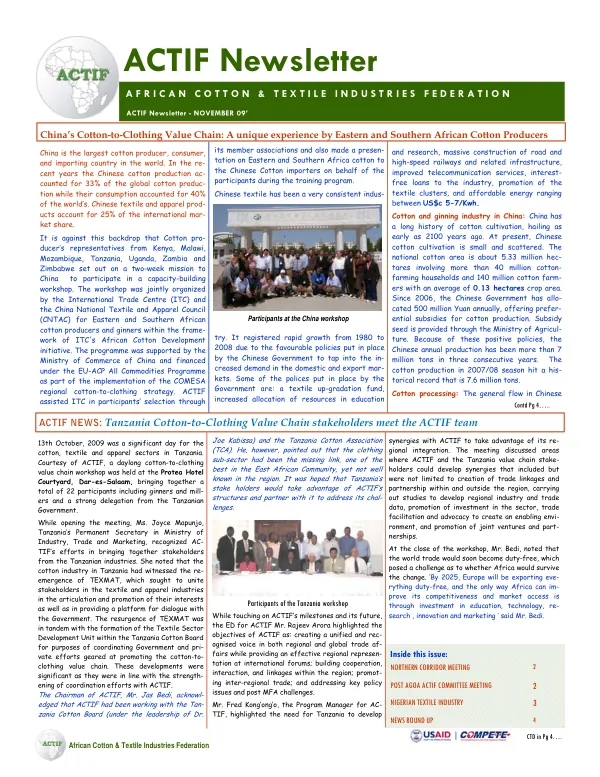
ACTIF Newsletter March 2011 D2
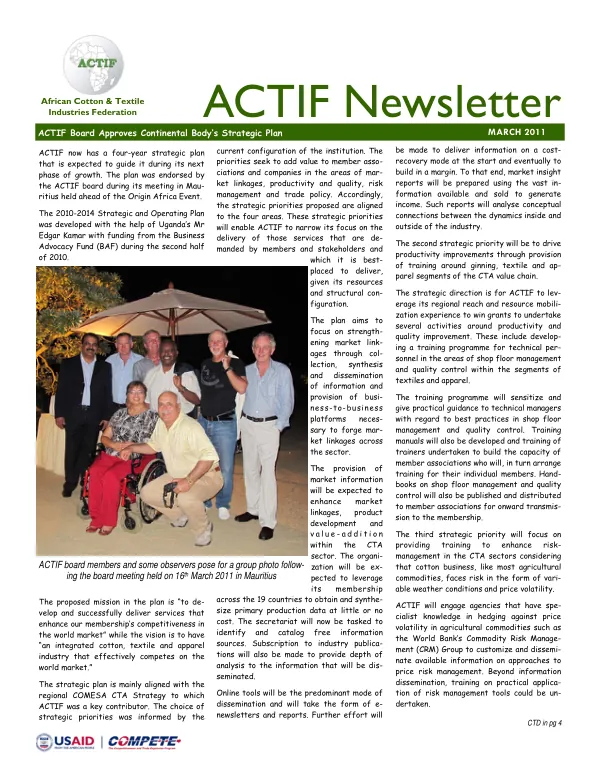
The African Cotton and Textile Industries Federation (ACTIF) has developed a four-year strategic plan to guide its growth during the 2010-2014 period.
2011 · 4 pages
Sign in to readA free account is required to download.
Abstract
The plan was endorsed by the ACTIF board during its meeting in Mauritius, held ahead of the Origin Africa Event. The strategic plan was developed with the help of Uganda's Mr. Edgar Kamar, with funding from the Business Advocacy Fund (BAF) during the second half of 2010. The proposed mission in the plan is to develop and successfully deliver services that enhance the competitiveness of ACTIF's membership in the world market. The vision is to have an integrated cotton, textile, and apparel industry that effectively competes on the world market. The strategic plan is mainly aligned with the regional COMESA CTA Strategy, to which ACTIF was a key contributor. The strategic priorities proposed by ACTIF seek to add value to member associations and companies in the areas of market linkages, productivity, and quality, risk management, and trade policy. The priorities focus on strengthening market linkages through the collection, synthesis, and dissemination of information and the provision of business-to-business platforms necessary to forge market linkages across the sector. ACTIF aims to leverage its membership across 19 countries to obtain and synthesize primary production data at little or no cost. The organization will identify and catalog free information sources, subscribe to industry publications, and use online tools to disseminate information. Market insight reports will be prepared using the vast information available and sold to generate income. The second strategic priority is to drive productivity improvements through the provision of training around ginning, textile, and apparel segments of the CTA value chain. ACTIF will leverage its regional reach and resource mobilization experience to win grants to undertake several activities around productivity and quality improvement. These include developing a training program for technical personnel in the areas of shop floor management and quality control. The third strategic priority focuses on providing training to enhance risk management in the CTA sectors. ACTIF will engage agencies that have specialist knowledge in hedging against price volatility in agricultural commodities to customize and disseminate available information on approaches to price risk management. Beyond information dissemination, training on practical application of risk management tools could be undertaken. Innovative business models can offer a competitive advantage to the textile and apparel industry. Companies should regularly review their business models, seek and develop business models that differentiate their offering, and evaluate their use of technology and information systems. Key elements to consider when building a new business model or evolving an existing one include outsourcing production, sourcing strategically or opportunistically, increasing the number of collections in a year, and having shorter product life cycles. The Origin Africa Trade show event was successfully held on 16th-18th March 2011 in Mauritius. The Fiber to Fashion event highlighted the creativity and innovation of the African cotton, textile, and clothing industries, and raised the profile of the continent as a source of supply of cotton, textile products, fabrics, and clothing. The event featured a platform for business, inspiration, innovation, and technology, as well as a pan-African graphic design show and an origin Africa designer showcase. ACTIF has appointed Intertek Mauritius as the lead consulting firm to conduct a supply side analysis for the cotton value chain in four Eastern African countries, namely Kenya, Uganda, Tanzania, and Ethiopia. The primary objective of the study is to profile the cotton textile and apparel sectors of the Eastern Africa region. The study is expected to provide a source of information for buyer/seller matchmaking to grow exports and encourage regional integration, monitor growth (exports/employment trends), identify potential regional strengths (product emphasis) and weaknesses, and identify gaps in institutional structures and communication channels.