USAID
Active Management of the Third Stage of Labor (AMTSL)
The Active Management of the Third Stage of Labor (AMTSL) is a protocol designed to reduce postpartum hemorrhage and improve maternal and newborn outcomes.
2013 · 1 pages
Sign in to readA free account is required to download.
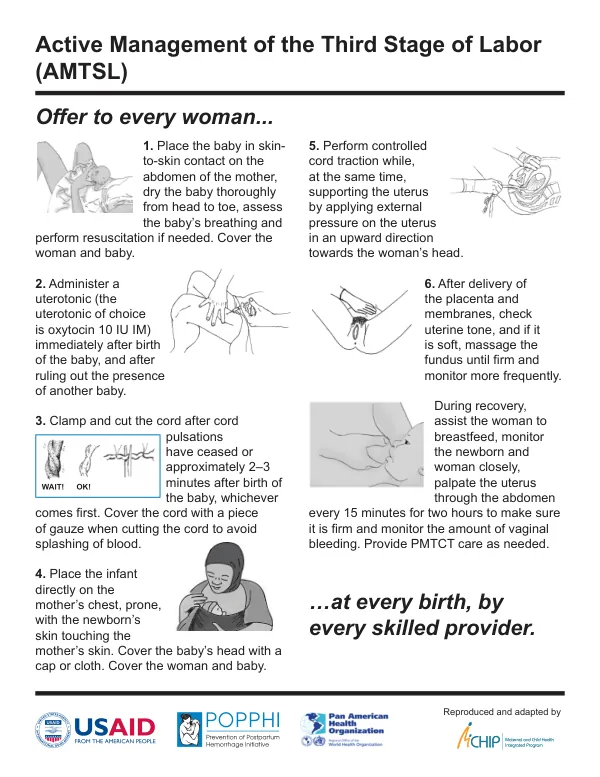
Abstract
This approach involves a series of steps to be taken immediately after birth. The first step is to place the baby in skin-to-skin contact on the abdomen of the mother, dry the baby thoroughly from head to toe, assess the baby's breathing, and perform resuscitation if needed. The mother and baby are then covered to maintain warmth. Administration of a uterotonic is the next step, with oxytocin being the uterotonic of choice. This medication is given immediately after birth, provided there are no contraindications and the presence of another baby has been ruled out. The uterotonic helps to stimulate uterine contractions and reduce bleeding. Clamping and cutting the umbilical cord is the subsequent step. This is done after cord pulsations have ceased or approximately 2-3 minutes after birth, whichever comes first. To avoid splashing of blood, the cord is covered with a piece of gauze when cutting. The infant is then placed directly on the mother's chest, prone, with the newborn's skin touching the mother's skin. The baby's head is covered with a cap or cloth, and the mother and baby are covered to maintain warmth. Active Management of the Third Stage of Labor involves offering this protocol to every woman at every birth, by every skilled provider. Controlled cord traction is performed while supporting the uterus with external pressure in an upward direction towards the woman's head. This helps to reduce bleeding and promote uterine contractions. After delivery of the placenta and membranes, the uterine tone is checked, and if it is soft, massage of the fundus is performed until it becomes firm. The woman is then assisted to breastfeed, and the newborn and woman are closely monitored. The uterus is palpated through the abdomen every 15 minutes for two hours to ensure it is firm, and vaginal bleeding is monitored. Additionally, PMTCT care is provided as needed during the recovery period.