JOHNS HOPKINS UNIVERSITY
Maternal and Neonatal Health (MNH) Program Overview
The Maternal and Neonatal Health (MNH) Program is a global initiative aimed at reducing maternal and newborn deaths through increased access to skilled maternal and newborn healthcare services.
2015 · 2 pages
Sign in to readA free account is required to download.
Abstract
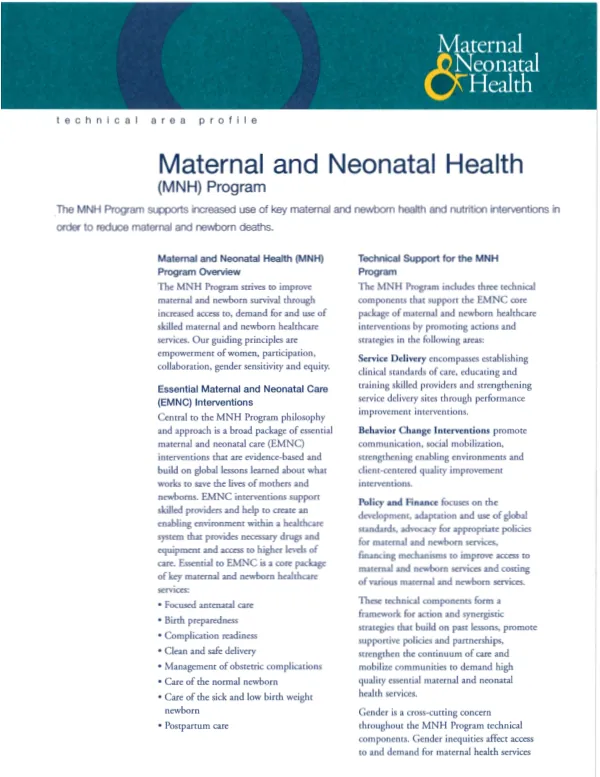
The program's guiding principles include empowerment of women, participation, collaboration, gender sensitivity, and equity. A broad package of essential maternal and neonatal care (EMNC) interventions is central to the program's philosophy and approach, which are evidence-based and build on global lessons learned about what works to save the lives of mothers and newborns. The EMNC interventions support skilled providers and help create an enabling environment within a healthcare system that provides necessary drugs and equipment and access to higher levels of care. The core package of key maternal and newborn healthcare services includes focused antenatal care, birth preparedness, complication readiness, clean and safe delivery, management of obstetric complications, care of the normal newborn, care of the sick and low birth weight newborn, and postpartum care. These interventions are designed to be culturally sensitive, sustainable, and appropriate for scaling up for broader impact. The MNH Program includes three technical components that support the EMNC core package of maternal and newborn healthcare interventions. Service Delivery encompasses establishing clinical standards of care, educating and training skilled providers, and strengthening service delivery sites through performance improvement interventions. Behavior Change Interventions promote communication, social mobilization, strengthening enabling environments, and client-centered quality improvement interventions. Policy and Finance focuses on the development, adaptation, and use of global standards, advocacy for appropriate policies for maternal and newborn services, financing mechanisms to improve access to maternal and newborn services, and costing of various maternal and newborn services. Gender is a cross-cutting concern throughout the MNH Program technical components. Gender inequities affect access to and demand for maternal health services, with impacts at the policy, facility, community, and household levels. Gender-sensitive design is integral to increasing the quality of clinical and supportive care that the woman receives both in the facility and in the community. The program's technical components form a framework for action and synergistic strategies that build on past lessons, promote supportive policies and partnerships, strengthen the continuum of care, and mobilize communities to demand high-quality essential maternal and neonatal health services. The MNH Program is responsible for integrating and linking two levels of activity: Global Leadership and Country and Regional Programs. Global Leadership focuses on setting global technical standards for maternal and newborn healthcare, contributing to lessons learned, disseminating information, building capacity, refining standards and program interventions, mobilizing commitment and strengthening program coordination and collaboration among national and local leaders, multilateral and bilateral stakeholders, building on global lessons about care for mothers and newborns, identifying, disseminating, and scaling up proven, cost-effective interventions, and identifying global research and evaluation needs to support maternal and newborn survival. The Global Leadership strategy informs and guides the development of the second level of activities, Country and Regional Programs, which reflect the global technical standards and benefit from networking and sharing information, lessons learned, and best practices.
Related documents