USAID DEC
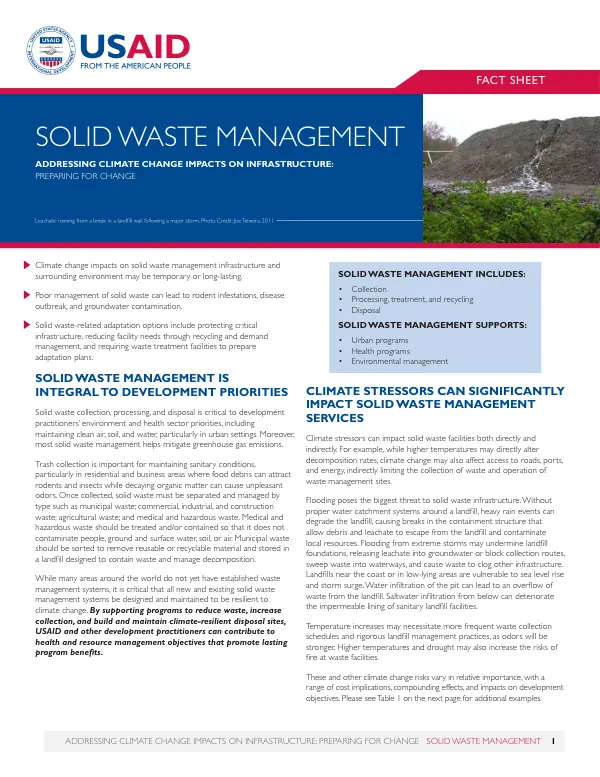
Addressing Climate Change Impacts on Infrastructure: Preparing for Change - Solid Waste Management
Sign inUSAID
Addressing Climate Change Impacts on Infrastructure: Preparing for Change - Solid Waste Management
Climate change impacts on solid waste management infrastructure and surrounding environment may be temporary or long-lasting.
2014 · 3 pages
Sign in to readA free account is required to download.
Abstract
Poor management of solid waste can lead to rodent infestations, disease outbreaks, and groundwater contamination. Solid waste-related adaptation options include protecting critical infrastructure, reducing facility needs through recycling and demand management, and requiring waste treatment facilities to prepare adaptation plans. Solid waste collection, processing, and disposal is critical to development practitioners' environment and health sector priorities, including maintaining clean air, soil, and water, particularly in urban settings. Most solid waste management helps mitigate greenhouse gas emissions. Trash collection is important for maintaining sanitary conditions, particularly in residential and business areas where food debris can attract rodents and insects while decaying organic matter can cause unpleasant odors. Once collected, solid waste must be separated and managed by type, such as municipal waste, commercial, industrial, and construction waste, agricultural waste, and medical and hazardous waste. Medical and hazardous waste should be treated and/or contained so that it does not contaminate people, ground and surface water, soil, or air. Municipal waste should be sorted to remove reusable or recyclable material and stored in a landfill designed to contain waste and manage decomposition. While many areas around the world do not yet have established waste management systems, it is critical that all new and existing solid waste management systems be designed and maintained to be resilient to climate change. Climate stressors can impact solid waste facilities both directly and indirectly. For example, while higher temperatures may directly alter decomposition rates, climate change may also affect access to roads, ports, and energy, indirectly limiting the collection of waste and operation of waste management sites. Flooding poses the biggest threat to solid waste infrastructure. Without proper water catchment systems around a landfill, heavy rain events can degrade the landfill, causing breaks in the containment structure that allow debris and leachate to escape from the landfill and contaminate local resources. Landfills near the coast or in low-lying areas are vulnerable to sea level rise and storm surge. Water infiltration of the pit can lead to an overflow of waste from the landfill. Saltwater infiltration from below can deteriorate the impermeable lining of sanitary landfill facilities. Temperature increases may necessitate more frequent waste collection schedules and rigorous landfill management practices, as odors will be stronger. Higher temperatures and drought may also increase the risks of fire at waste facilities. These and other climate change risks vary in relative importance, with a range of cost implications, compounding effects, and impacts on development objectives. USAID and other development practitioners can identify adaptation action priorities and integrate them into existing improvement and maintenance programs. Waste collection and disposal facilities are critical to protecting human health and local resources, particularly water and soil resources. Regular collection, particularly in residential areas, reduces exposure to contaminated waste and disease-carrying rodents and insects. Properly sited, constructed, and maintained disposal facilities can minimize the risk of water and soil contamination from the consequences of climate change impacts. Reducing the amount of solid waste stored in landfills is one of the easiest ways to reduce their vulnerability. Establishing waste sorting and recycling facilities can create local jobs and provide work for trash pickers whose livelihoods were compromised by a more robust municipal waste collection system. Recycling also reduces resource use and the amount of waste that must be managed in a landfill. Proper siting of landfills is another low-cost adaptation option. Landfills should be sited in areas where there is reliable access to the dumping site but away from bodies of water and areas with high water tables. Sites should be selected based on the municipality's long-term planning objectives and include input from the public. Through a screening process, adaptation action priorities can be selected based on local decision-makers' assessment of the following four key factors: criticality, likelihood, consequences, and resources available.