SAVE THE CHILDREN FUND
Addressing Gender-Related Barriers to Better Nutritional Behaviors
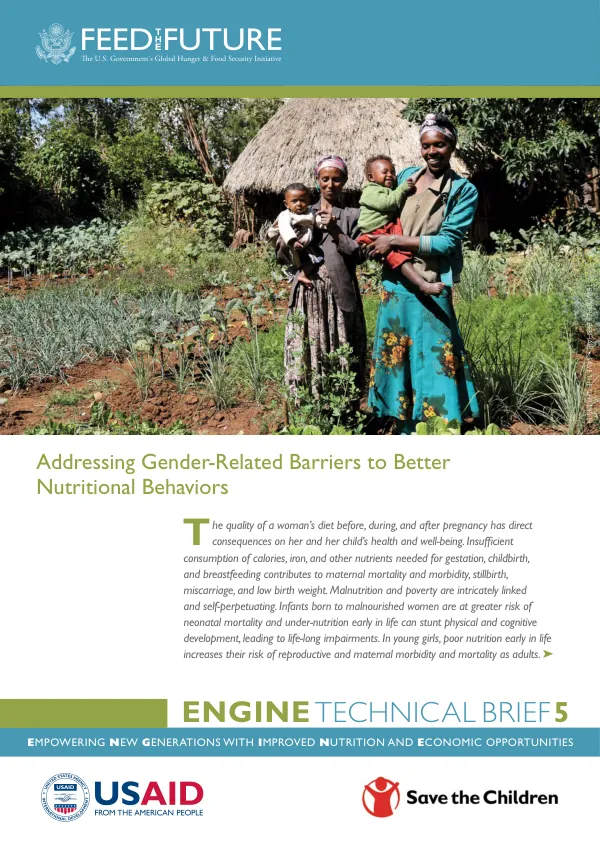
The quality of a woman's diet before, during, and after pregnancy has direct consequences on her and her child's health and well-being.
2016 · 4 pages
Sign in to readA free account is required to download.
Abstract
Insufficient consumption of calories, iron, and other nutrients needed for gestation, childbirth, and breastfeeding contributes to maternal mortality and morbidity, stillbirth, miscarriage, and low birth weight. Malnutrition and poverty are intricately linked and self-perpetuating. Infants born to malnourished women are at greater risk of neonatal mortality and under-nutrition early in life can stunt physical and cognitive development, leading to life-long impairments. In young girls, poor nutrition early in life increases their risk of reproductive and maternal morbidity and mortality as adults. In Ethiopia, women and children are the most likely groups to suffer from malnutrition. However, nutrition programs that target only this group neglect to address several of the underlying causes of women's struggle to meet their nutritional needs, most notably the inequities in marital and family relationships that inhibit women's capacity to ensure good nutrition for themselves and their children. Marriage has been found to positively correlate with improved nutrition status for women in Ethiopia. However, power imbalances between husband and wife can prevent women from meeting their nutritional needs. Inequities in access to education and information exacerbate power imbalances in marital relationships and limit women's ability to advocate for healthy choices for themselves and their children. The proportion of female respondents who had received no formal education was 60 percent higher than men and nearly twice as many women as men had no access to radio or television. Women are less likely to have control over crucial resources related to nutrition security and less likely to be able to make independent decisions regarding income. Just one-quarter of women said they could make decisions regarding the use of their husbands' income; 44 percent of men reported independently deciding how to spend their wife's income. Women spend more time working at home than men: 49 percent of women but just 15 percent of men spend more than six hours a day on food preparation and serving. Forty-three percent of women spent four to six hours per day on non-food related chores; 55 percent of men spent less than two hours on these tasks. To address these issues, ENGINE conducted focus group discussions, key informant interviews, expert interviews, and site observations with 470 male and female community members in 83 project-supported woredas. The research also assessed the gender mainstreaming capacity and institutional practices of ENGINE and regional Ministry of Women, Children, and Youth Affairs bureaus. ENGINE developed its gender strategy, which focused on enhancing capacities and policies regarding gender issues at the institutional level and improving women's access to and control of resources and information at the community level. The strategy included enhancing institutional capacity and policy environment for gender mainstreaming, improving women's access to and control of resources and information, and implementing ENGINE's Gender Strategy. The strategy also included training for health and agriculture extension workers on the impact of gender roles on women and children's nutrition. ENGINE's greatest impact on gender relationships and women's access to nutritious food arguably stemmed from its interventions with most vulnerable households (MVHHs) participating in the nutrition-sensitive livelihoods activities and through enhanced community conversations (ECCs). Women constituted the majority of participants in the MVHH livelihoods activities. ENGINE purposively designed the activity in this way to empower women. However, through the use of the Gender Checklist, ENGINE discovered that because only one member of each MVHH was invited to the orientation sessions, some men forbade their wives from participating. The project held orientation meetings for 7,319 men to provide information on the package of activities offered to the MVHHs, maternal, infant, and young child nutrition (MIYCN), nutrition-sensitive agriculture, and actions men could take to be supportive of their wives' efforts to improve the family's diet. To further engage men, ENGINE provided decision-making and communications skills training, particularly regarding MIYCN practices, for more than 4,498 male members of MVHHs. ECCs engaged husbands and fathers, mothers, and grandmothers in discussions regarding barriers to practicing optimal MIYCN behaviors, including gender roles and family relationships. Nearly 37,500 people, one-third of whom were men, participated in the meetings. The ECCs proved to be particularly effective in inspiring improvements in marital relationships, which in turn allowed women greater access to necessary resources for MIYCN. To bolster these results, ENGINE identified male ECC participants who were exceptionally supportive of their wives and children, certified them as role models, and recognized them for their positive actions at community events. Results from an assessment of the ECCs are positive as well; 69 percent of men reported positive changes in male maternal nutrition behaviors, which enable their wives to eat larger quantities and more diversity of foods, reduce their workloads, and take iron folate supplements during pregnancy.