USAID DEC
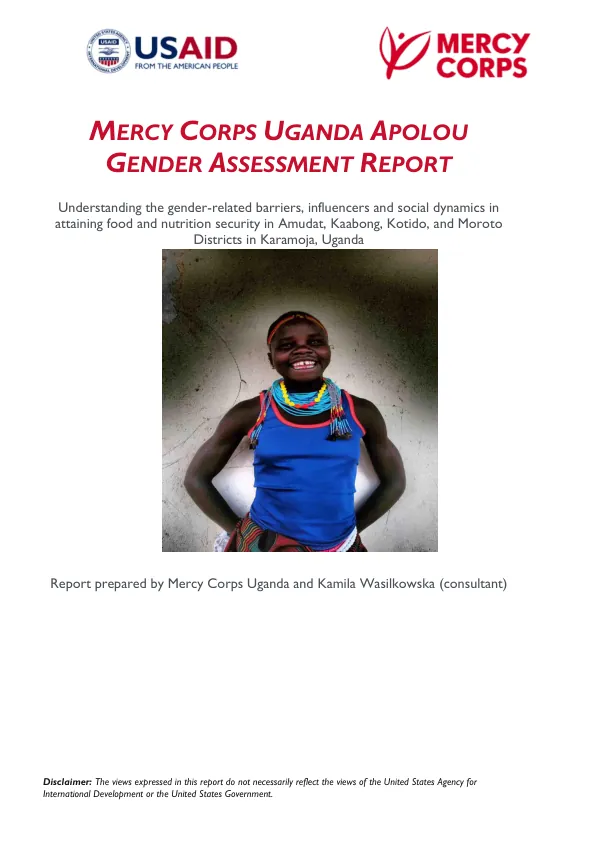
Gender Assessment Report: Understanding the gender-related barriers, influencers and social dynamics in attaining food and nutrition security in Amudat, Kaabong, Kotido, and Moroto Districts in Karamoja, Uganda
Sign inUSAID
Gender Assessment Report: Understanding the gender-related barriers, influencers and social dynamics in attaining food and nutrition security in Amudat, Kaabong, Kotido, and Moroto Districts in Karamoja, Uganda
In Karamoja, Northern Uganda, the Apolou Activity aims to improve food and nutrition security of vulnerable households in Amudat, Kaabong, Kotido, and Moroto Districts.
2019 · 53 pages
Sign in to readA free account is required to download.
Abstract
The study aimed to understand how gender norms and cultural practices impact women's and men's experiences, perceptions, and utilization of MCHN, WASH, and livelihoods services; and participation in governance structures. The assessment had two main aims: to gather evidence on the existing gender dynamics that impact each of the four purpose areas, and to inform strategies and approaches for gender integration. The study engaged 2,132 participants, including 1365 adolescents, 375 adolescent caregivers, and 392 men and women through surveys, key informant interviews, and focus group discussions. Data collection occurred from October 2018 and March 2019, using a team of 22 research assistants and supervisors. The adolescent consultations methodology used open-ended questions to collect data through listening and learning from their experiences. Survey data was analyzed through STATA and disaggregated by gender, district, group membership, and level of education. The findings indicate that men owned and controlled property, while women sometimes owned low-value stocks such as goats and sheep. Women did not own property such as land and cattle. Men and women had unequal rights over their own bodies, with women expected to comply with their wifely and motherly duties. Men controlled and dominated over women, while women were expected to be submissive as a sign of respect. Boys and girls were socialized on gender norms from a very tender age, with girls having more chores compared to boys. The study also found that alcoholism was a significant social force with serious health implications in Karamoja. Alcohol abuse remained high and affected intra-household dynamics, triggering conflict and violence and exacerbating cycles of poverty. The high alcohol consumption also led to brewing becoming a major source of livelihood for young women, exposing them to risks of violence from consumers. Gender-based violence was also prevalent, with most GBV clients being women and girls who had been assaulted either physically or sexually. The age groups affected spanned 5-45 years, with majority being adolescent girls who were in particular danger when walking to collect water. The study highlights the need to address the existing gender dynamics that impact the four purpose areas, including governance, MCHN, WASH, and livelihoods. The findings suggest that strategies and approaches for gender integration should focus on promoting gender equality, addressing unequal rights over bodies, and promoting women's participation in governance and livelihoods programs. The study also recommends addressing the root causes of alcoholism and GBV, including poverty and lack of access to education and economic opportunities.