USAID DEC
Enhanced Community Conversations: Engaging Communities through Nutrition and Economic Opportunities
Sign inSAVE THE CHILDREN FUND
Enhanced Community Conversations: Engaging Communities through Nutrition and Economic Opportunities
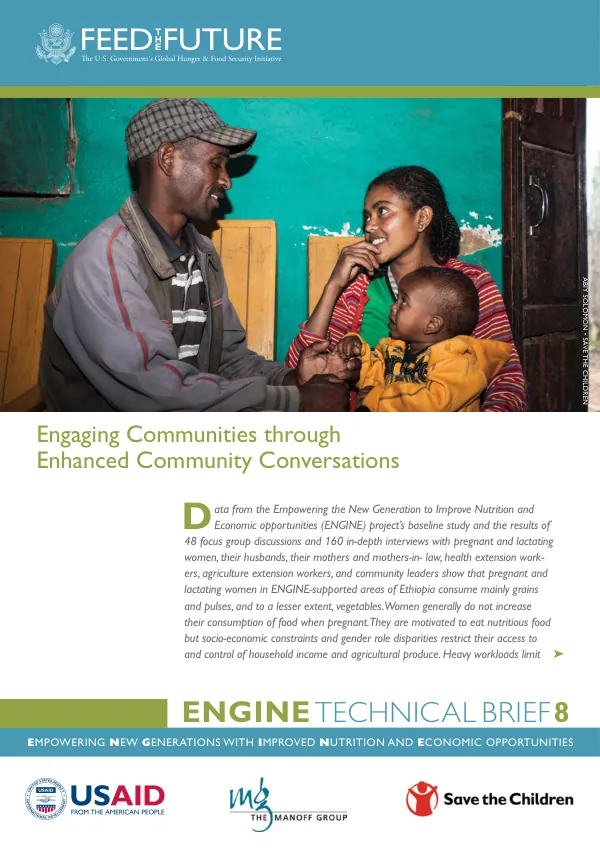
The ENGINE project's baseline study and focus group discussions revealed that pregnant and lactating women in Ethiopia consume mainly grains and pulses, with limited consumption of vegetables.
2013 · 8 pages
Sign in to readA free account is required to download.
Abstract
Women are motivated to eat nutritious food but face socio-economic constraints and gender role disparities that restrict their access to and control of household income and agricultural produce. Heavy workloads and cultural values also limit women's time available to rest and prepare food for themselves. The diets of children in the region are also suboptimal, with low diversity and a lack of animal source and micronutrient-rich foods. Water, sanitation, and hygiene (WASH) environments in their homes put them at high risk for stunting. To address these barriers, the ENGINE project developed an evidence-based social and behavior change communication (SBCC) strategy that focuses on behavior-centered programming. The SBCC strategy positions nutrition as "A Family Affair" and promotes evidence-based behaviors to reduce chronic under-nutrition in children under two years of age. The strategy includes mass media, engagement with religious leaders, frontline health and agriculture workers, and community meetings. ENGINE implemented the first phase of its SBCC program, which included a pilot of community conversations about nutrition. During this phase, ENGINE trained 225 women and 15 men as community change agents (CCAs) to facilitate the meetings and established 120 community conversation groups. More than 3,500 community members attended the sessions, which increased participants' knowledge of nutrition. However, ENGINE encountered several challenges in implementation, including mixed groups, facilitating conversations with large numbers of people, and the CCAs' low-to-moderate literacy. To address these challenges, ENGINE developed an approach to enhance the meetings, known as Enhanced Community Conversations (ECCs). ECCs are smaller, homogenous groups that focus on promoting the adoption of nutrition-related skills, behaviors, and gender transformative roles. ECCs use interactive methods and activities, including role plays, games, contests, and singing, to help adults learn. Participants receive take-home materials or activities to spark discussion with their families and neighbors. ENGINE engaged three local nongovernmental organizations to facilitate implementation of 1,872 ECCs in 30 woredas. A total of 37,440 fathers, mothers, and grandmothers attended, with 75 percent graduating by having attended eight or more sessions. The ECCs used creative concepts, such as the Sunflower Stages concept and the Star Foods concept, to support communication about maternal, infant, and young child nutrition (MIYCN). The ECCs also used interactive materials, including audio recordings of virtual facilitators (VFs) and printed materials, to promote dietary diversity and other nutrition-related behaviors. The VFs, Aya Mulat and Ete Birtukan, helped facilitate the group activities and provided advice on nutrition and nutrition-sensitive agriculture. The ECCs also used games and role plays to help participants practice planning nutritious menus and improving decision-making regarding household spending. The results of the ECCs showed that 41 percent of men and 29 percent of women reported making positive changes in their relationship with their spouse, and 38 percent of men and 31 percent of women reported changes in their relationship with their family. The ECCs were effective in promoting the adoption of nutrition-related skills, behaviors, and gender transformative roles, and in improving the diets of children in the region.