MINISTRY OF AGRICULTURE
Nutrition-Sensitive Agriculture Interventions
Nutrition-Sensitive Agriculture Interventions in Ethiopia began with the Empowering the New Generation to Improve Nutrition and Economic Opportunities (ENGINE) project, which aimed to increase the diversity of food available and sold in the country.
2016 · 8 pages
Sign in to readA free account is required to download.
Abstract
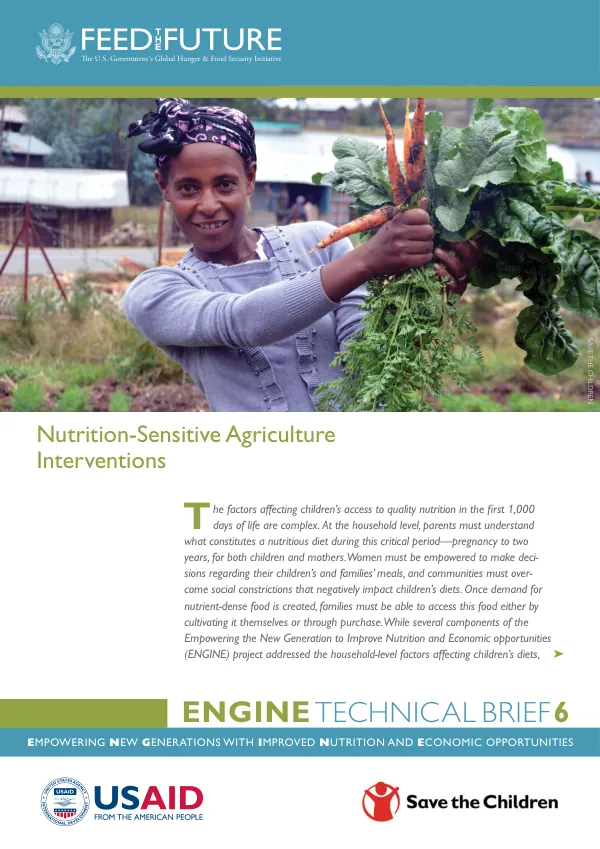
The project focused on supporting agricultural productivity and commercialization, particularly in the cultivation of nutrient-dense produce and production of animal products at the household level. The ENGINE project worked with the Ministry of Agriculture's (MOA) farmer training centers (FTCs) and model farmer approaches to disseminate nutrition-sensitive agriculture (NSA) information and techniques to communities. Through classroom-based and on-the-job training, agricultural extension workers (AEWs) learned how to train farmers to cultivate vegetables and fruits and cook these nutrient-dense crops to diversify their families' diets. The project identified two to four FTCs in each project-supported woreda where AEWs provided nutrition education and demonstrated homestead gardening, small livestock and poultry husbandry, and cooking techniques. AEWs also provided follow-up support to farmers during home visits and facilitated the purchase of seeds. Through the FTCs, AEWs reached the most vulnerable households (MVHHs) and expanded the project's reach to small shareholder farmers. The ENGINE project also supported the Government of Ethiopia's model farmer approach to disseminate NSA information and techniques more directly to communities in three kebeles adjacent to project-supported FTCs. The project educated 9,660 farmers who were early adopters of improved agricultural technologies, economically better-off, or regarded as thought leaders in their communities about the importance of proper nutrition and NSA strategies for homestead gardening and animal husbandry. The project promoted the cultivation of highly nutritious crops, including vegetables and fruits such as Swiss Chard, Avocado, Kale, Mango, Collard Green, Apple, Head cabbage, Papaya, Carrot, Orange-fleshed sweet potato, Irish potato (improved variety), Pumpkin, and Green beans. The project also supported the establishment of school gardens, where students participated in the management of the gardens and received vegetable seedlings to plant near their homes. The ENGINE project also supported the training of local communities in small livestock and poultry husbandry, providing livestock such as goats, sheep, cows, and chickens to MVHHs through its livelihoods component. The project found that raising chickens had a greater impact on families' nutrition than goats, sheep, or heifers, and identified a relatively low-cost, self-reproducing breed that lays 180 to 220 eggs per year and grows quickly. The project established a partnership with the private sector to establish a sufficient supply of chickens, upgrading two private chicken growers' hatcheries and providing them with incubators and parent koekoek stock obtained from research centers. The project also identified commercial out-growers who raised the chicks for two to three months until they were strong enough to survive in rural households. The ENGINE project also ensured a sustainable and reliable supply of vegetable seeds by identifying a private sector seed supplier or farmers' cooperative in each of 66 supported woredas. The project provided training in vegetable seed handling and linked the suppliers with vegetable-producing farmers, AEWs, and wholesalers in their surrounding areas. The project's work with FTCs and schools was challenging in the beginning, with a March 2014 study finding that just 76 percent of 106 FTCs assessed had carried out cooking or farming demonstrations, completing only 52 percent of the expected number in the two years prior to the study. However, subsequent to the assessment findings, ENGINE replaced the FTCs and schools that lacked the conditions necessary for farming, and the pace of demonstrations increased. By the project's end, ENGINE-supported FTCs and schools had reached 42,690 farmers with vegetable production and cooking demonstrations. The model farmer approach showed promise for rapidly disseminating NSA information and techniques to communities, with model farmers reporting growing more leafy greens, pumpkin, and sweet potato, and consuming part of their harvest and selling the rest, which has a positive impact on both their household's nutrition and the availability of fruits and vegetables in the market.