TETRA TECH
Advanced Training of PSM Inspector to Implement PSM Agreement
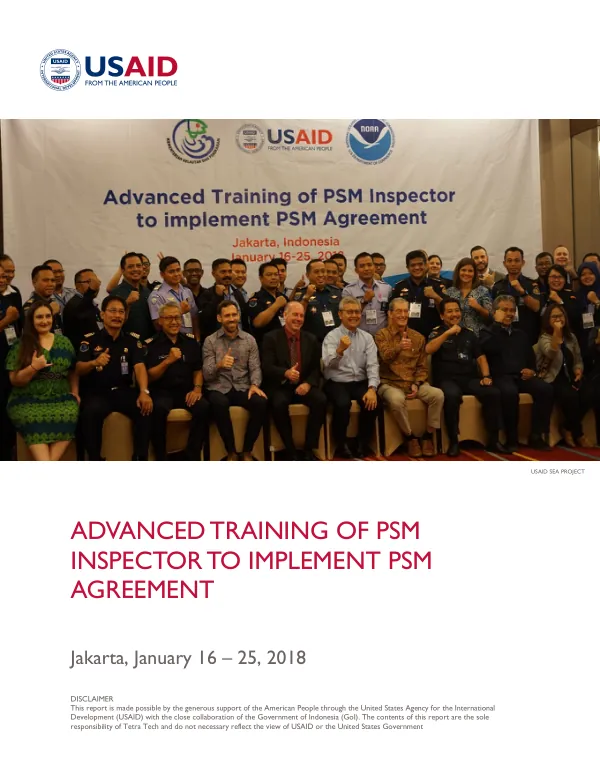
The Advanced Training of Port State Measures (PSM) Inspector to Implement PSM Agreement was conducted in Jakarta from January 16 to 25, 2018.
2018 · 21 pages
Sign in to readA free account is required to download.
Abstract
The training aimed to improve the capacity of fisheries surveillance officers to conduct inspections of foreign fishing vessels in accordance with the PSM Agreement. The Indonesian government, through Presidential Decree No. 14 of 2016, has ratified the PSM Agreement to prevent, deter, and eliminate illegal, unreported, and unrecorded fishing. The training was organized by the USAID SEA Project in collaboration with the NOAA Office of Law Enforcement and the Ministry of Marine Affairs and Fisheries (MMAF). The training team consisted of experts from NOAA, including Todd Dubois, Angelina Stella, Richard Chesler, Joseph Brenner, Katheryn Patterson, Nicholas Matsunaga, and Amy Rollins. A total of 35 participants, comprising 21 fisheries surveillance officers and 14 port officers, attended the training from 5 designated ports. The training design consisted of 8 days of training, including 3 days of classroom sessions and 4 days of boarding simulation, as well as a 1-day feedback session. The training combined classroom sessions and boarding simulation to boost knowledge about PSM and technical aspects in inspecting foreign fishing vessels and port services. The training covered 8 key sessions, including operational requirements of the PSM Agreement, pre-arrival activities and risk assessment, and conducting a PSM inspection. The training aimed to achieve several objectives, including improving understanding of fisheries surveillance officers of international and Indonesian legal context and purpose of the PSM Agreement, conditioning fisheries surveillance officers to be conversant with the relevant provisions of the PSM Agreement, and improving capacity of fisheries surveillance officers to conduct pre-arrival checking, on-board inspection, and know how to deliver the port service. The training yielded positive results, with 80 percent of participants receiving scores above 90 on the post-test. The participants appreciated the training, which enhanced their capacity and technical knowledge in conducting inspections of foreign fishing vessels and reporting. They also viewed that the training enabled them to conduct inspections of PSMA, including increasing their knowledge on understanding RFMO, IMO, MMSI, and VMS tracking. The training was a collaborative effort between the USAID SEA Project, NOAA Office of Law Enforcement, and the MMAF. The project aims to support the Indonesian government in implementing the PSM Agreement and improving marine resource management. The training is part of a series of capacity-building activities on PSMA, fisheries management, and IUU fishing in various countries. The USAID SEA Project is a five-year project supporting the Government of Indonesia to conserve biodiversity and improve marine resource management at local, district, provincial, and national levels. The project aims to improve the conservation and sustainable use of resources by reforming fisheries management and promoting marine protected areas to encourage productivity of fishery products, food and nutrition security, and sustainable livelihoods in targeted areas. The project supports the strengthening of the capacity of the MMAF in the implementation of the PSM Agreement, which has been ratified by the Indonesian government through Presidential Regulation No. 43 of 2016. The project aims to improve the capacity of fisheries surveillance officers in terms of authority to provide port services or deny giving services to IUU fishing vessels or to grant port entry for further inspection.