USAID DEC
Coordination and Consultation Workshop for Initiating Harvest Strategies Development for Small-Pelagic, Demersal, Flying Fish, Anchovy, and Turf in 715 FMA
Sign inGOVERNMENT OF INDONESIA
Coordination and Consultation Workshop for Initiating Harvest Strategies Development for Small-Pelagic, Demersal, Flying Fish, Anchovy, and Turf in 715 FMA
The Indonesian government has developed and issued Fisheries Management Plan (FMP/Rencana Pengelolaan Perikanan-RPP) for 715 FMA, as appeared in Marine Affairs and Fisheries Minister’s Decree No.
2018 · 126 pages
Sign in to readA free account is required to download.
Abstract
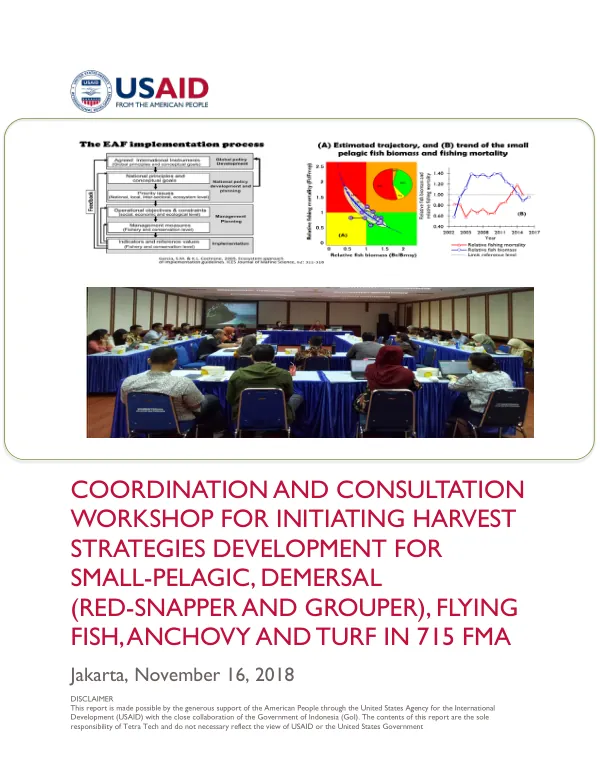
82/KEPMEN-KP/2016. Demersal small- and big-pelagic fisheries are priorities in 715 FMA. Most of the fisheries within 715 FMA are classified as fully-exploited and prawn and big-eye tuna are classified as over–exploited. To reduce this threat of overfishing, there is a strong need of policy to manage the fishery resources. For this purpose, stock assessment for harvest strategy is required. USAID Sustainable Ecosystem Advanced (SEA) Project provides support to strengthen the Indonesian fisheries management including harvest strategy development for targeted species (red-snapper; grouper, and small-pelagic). The Project conducted various activities in the first year of the USAID SEA Project implementation (2016/2017), including data collection management workshops and trainings. During the 2018, several milestones activities have been conducted including one-year fish landing data collection and stock assessment analysis using fishery statistic data with non-equilibrium BDM. The findings of the stock assessments for demersal and small-pelagic were presented and endorsed by KOMNAS KAJISKAN. Also, USAID SEA Project has been working and providing capacity developing for MMAF leading fisheries researchers-PUSRISKAN- that who will lead the scientific committee of the harvest strategy development. The objectives of the workshop were to share current progress of sustainable fisheries activities on small-pelagic, demersal (red-snapper), flying fish, anchovy and TURF, to synchronize the perspectives across MMAF units on harvest strategy and its initiation direction, and to identify collaborative actions towards harvest strategy development. The workshop was held at MMAF office, Arwana Meeting Room, Gedung Mina Bahari II Lantai 14, Kementerian Kelautan dan Perikanan. Jl. Medan Merdeka Timur No 16 Jakarta. The agenda of the workshop included presentations from USAID SEA Project, Dit PSDI, and USAID SEA Partners. The meeting opened by Mr. Yuliadi, Acting Director of Fisheries Resources Management Directorate, who pointed out some points, including the importance of smooth and solid coordination and evaluation of any activities related to USAID SEA Project and PSDI. The Sub-Directorate of Fisheries Resources in Territorial and Archipelagic Waters (Dr. Besweni) presented that USAID SEA Project can help to activate and operationalize the Fisheries Management Council of 715 FMA, ensuring the operationalization does not only focus on the stakeholder’s engagement but also on Harvest Strategy development, vessel licensing, marine resources conservation, surveillance, and logbook implementation. Some challenges in managing fisheries resources through Fisheries Management Area include weak and lack of coordination and synergy in fisheries management stakeholders or department, fish stock biological boundaries and mobility can across several provinces, and Indonesia waters have high biodiversity where every FMA has different fisheries ecosystem characteristics. The workshop also highlighted the importance of the Ministerial Decree No. 82/2016 that states three (3) objectives of fishery management for 715 FMA: ensuring sustainability of fish resources and critical habitats, ensuring the sustainability of fish resources and critical habitats, and ensuring the sustainability of fish resources and critical habitats. The workshop concluded with a call for regular meetings to coordinate and evaluate SEA Project-related activities and to identify challenges and opportunities to improve outcomes-related to IKU-KKP (MMAF-main performance indicators).
Related documents