AIDER
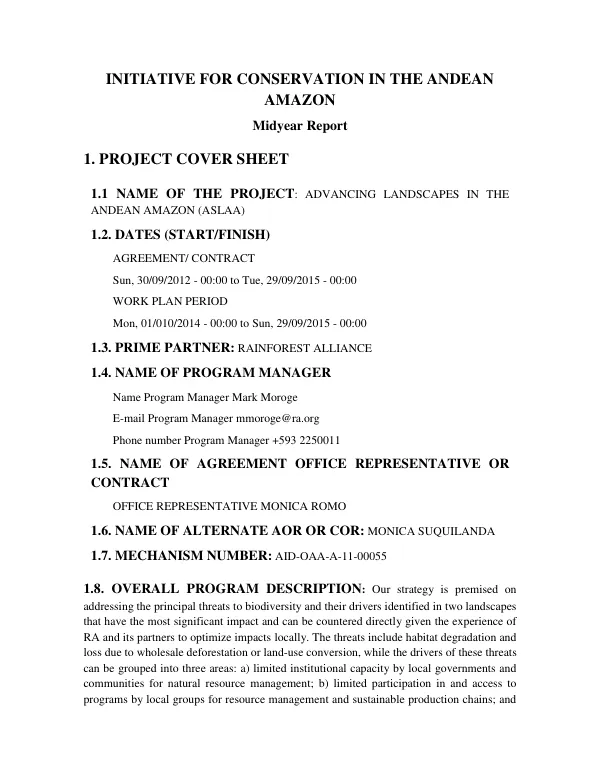
Advancing Landscapes in the Andean Amazon (ASLAA)
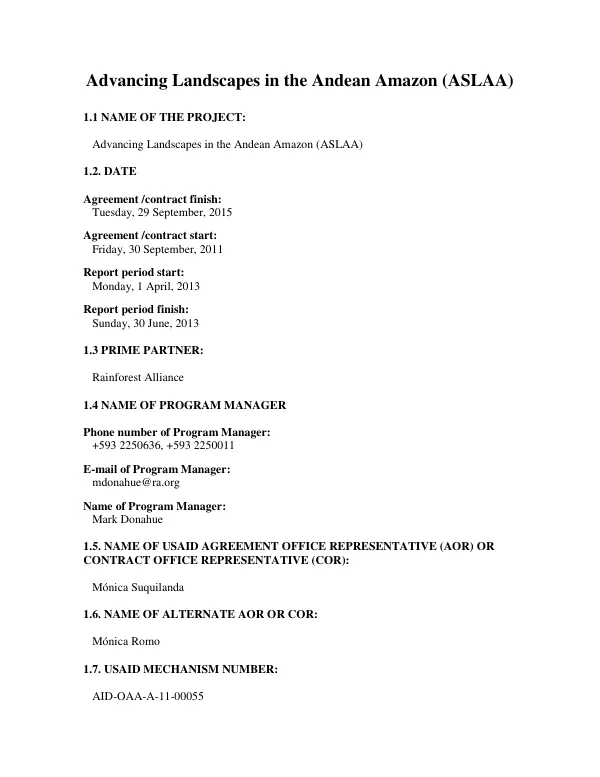
Advancing Landscapes in the Andean Amazon (ASLAA) is a project that aimed to conserve biodiversity in two landscapes, Sucumbíos/Napo, Ecuador and Cusco/Madre de Dios, Peru.
2013 · 7 pages
Sign in to readA free account is required to download.
Abstract
The project was implemented by Rainforest Alliance (RA) and its partners, AIDER, and ECOLEX, with funding from USAID's agreement AID-OAA-A-11-00055. The project period started on April 1, 2013, and ended on June 30, 2013. The project focused on addressing the principal threats to biodiversity and their drivers in the two landscapes. The threats included habitat degradation and loss due to wholesale deforestation or land-use conversion, while the drivers of these threats were grouped into three areas: limited institutional capacity by local governments and communities for natural resource management, limited participation in and access to programs by local groups for resource management and sustainable production chains, and weak organizational capacity and market linkages of local producers and operators to grow local economic opportunities. In Ecuador, the project worked in the Cuyabeno Wildlife Reserve (CWR), the Limoncocha Biological Reserve (LBR), and the buffer zone of Sumaco – Napo Galeras National Park. In Peru, the project worked in the district of Tambopata in the communities of Tres Islas, Palma Real, Infierno, Sonene, and Puerto Arturo, as well as with the Brazil nut gatherer associations RONAP and ASCART. The project achieved several key outcomes, including the development of a sustainable tourism strategy for CWR, the implementation of a consultancy to identify socio-economic and cultural factors related to forest use in the Hatun Sumaku Parish, and the provision of technical assistance to the Tambopata National Reserve for locating camping places for bird watching. The project also finalized a study of limits of acceptable change for Sandoval Lake in the TNR and elaborated 30 new site sheets for tourism resources in the Tambopata area. In addition, the project improved environmental governance in the two landscapes by socializing tourism operations regulations manuals with key stakeholders, strengthening interagency agreements to improve security in tourism areas, and participating in the national process for implementing risk assessment. The project also strengthened the technical support group responsible for updating the Regional Biodiversity Strategy of the Regional Environmental Commission (CAR) and facilitated several meetings to obtain the commitment of organizations to work together. Furthermore, the project improved sustainable livelihoods and ecosystem resilience in the two landscapes by facilitating a visit by the regional MAGAP representative to present the national reforestation incentives program to project communities, supporting ASCART in winning public financing for their business plan, and accessing soft credits from AGROBANCO for Brazil nut harvest. The project also developed low-intensity participatory forest management plans for three communities, which were approved by the Regional Forest Authority, and are currently being implemented. The project's geographic focus was on the Sucumbíos/Napo landscape in Ecuador and the Cusco/Madre de Dios landscape in Peru. The project's timeframes were from September 30, 2011, to September 29, 2015, with the report period starting on April 1, 2013, and ending on June 30, 2013.
Related documents