MERCY CORPS INTERNATIONAL
FY18 Semi-annual Report: BAMBARI & OUAKA URGENT NEEDS RESPONSE (BOURNE)
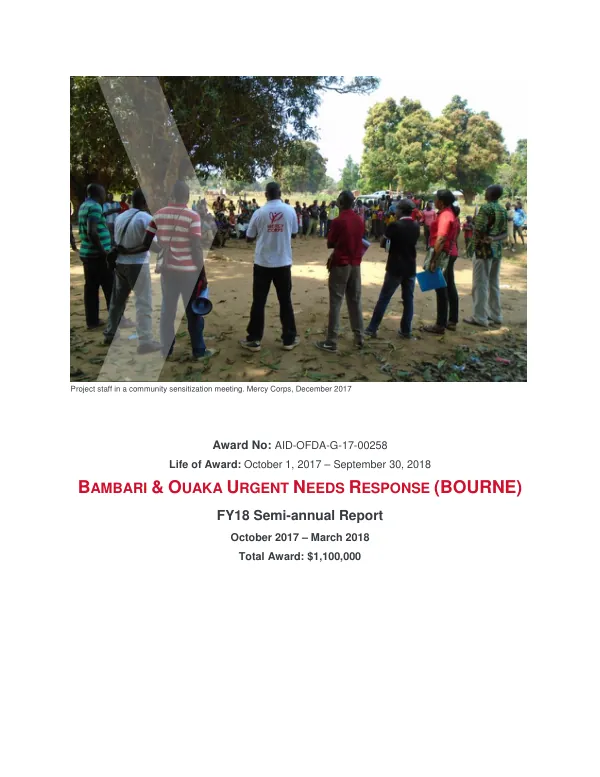
The Bambari and Ouaka Urgent Needs Response (BOURNE) program is a 12-month initiative designed to address the needs of returnees and host families in Bambari city and the Ouaka region.
2018 · 9 pages
Sign in to readA free account is required to download.
Abstract
Funded by USAID/OFDA, the program targets 7,500 beneficiaries, including 1,000 households for non-food item (NFI) kits, 900 people for shelter assistance, and 3,600 people for socio-economic restoration support. The program's reporting period, October 1, 2017 to March 31, 2018, was characterized by several episodes of insecurity in the intervention areas. Despite this, the BOURNE program carried out a baseline evaluation to refine its implementation strategies for each sector. The baseline report identified 1,000 potential beneficiaries for shelter rehabilitation, CFW, and Income Generating Activities (IGAs). The project team conducted 820 home visits to verify beneficiaries' information and selected 112 beneficiaries for shelter rehabilitation and 41 beneficiaries for CFW. The baseline report also identified two community markets for rehabilitation activities in Bakala and Maloum. The layout of each market's design plans was finalized in consultation with both communities, and Mercy Corps technical staff completed the design and procurement processes for construction materials and tools. The security situation in the Ouaka region remained volatile throughout the reporting period, with armed clashes between the UPC/FPRC and the AB causing numerous waves of displacement and reduced humanitarian access. Despite a peace agreement signed in Ippy in October 2017, armed clashes broke down again in early December, and the movement of armed groups significantly limited the BOURNE team's mobility. The BOURNE program team formed Community Management Committees (CMCs) in each village to ensure inclusive community participation for each program sector. The CMCs included village leaders, local authorities, and women and youth representatives, and were responsible for beneficiary selection and vulnerability criteria. Over the reporting period, the CMCs identified 545 potential beneficiaries for shelter rehabilitation, 275 beneficiaries for CFW activities, and 180 potential beneficiaries for IGAs. The program's objective is to meet the basic needs of vulnerable men, women, boys, and girls, including IDPs, returnees, and host-families, in conflict-affected communities. To address the overwhelming needs for NFI kits, Mercy Corps has included verification of NFI needs in all household verification visits. The items of NFI kits were modified based on priorities identified by target communities in the baseline evaluation, and two distributions of 350 kits each are planned in May, assuming the security situation permits. The program's shelter strategy was refined through extensive consultations with other international NGO partners and the NFI/Shelter cluster. For rural areas, the cluster recommended distributing shelter materials, including roofing sheets, nails, and wire mesh, to support the rehabilitation of damaged homes. The program team has completed the design and procurement processes for shelter materials and tools, and is awaiting the security situation to resume activities. The BOURNE program has made significant progress in implementing its activities, despite the challenging security situation. The program team has formed CMCs, identified beneficiaries, and completed the design and procurement processes for shelter materials and tools. The program's objective is to meet the basic needs of vulnerable populations, and the team is working to ensure that the program's activities are implemented safely and effectively.