MERCY CORPS INTERNATIONAL
BAMBARI & OUAKA URGENT NEEDS RESPONSE (BOURNE)
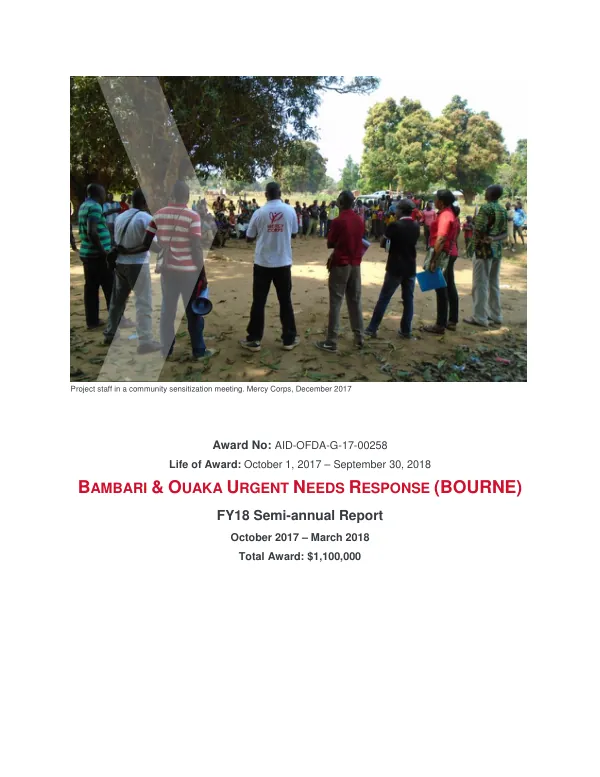
The Bambari and Ouaka Urgent Needs Response (BOURNE) project was designed to address the humanitarian needs of internally displaced persons (IDPs), returnees, and vulnerable households in the Bambari area of the Central African Republic.
2018 · 10 pages
Sign in to readA free account is required to download.
Abstract
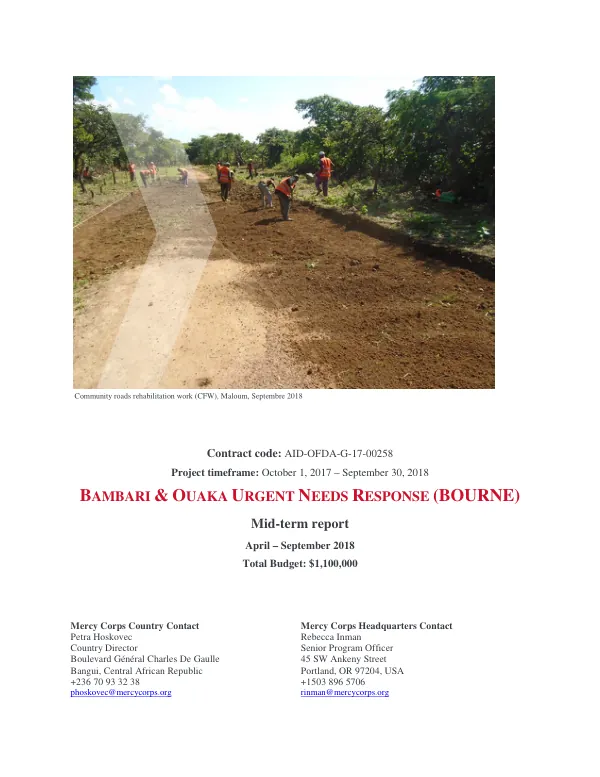
Funded by USAID/OFDA, the project targets 7,500 direct beneficiaries, including 1,000 households who will receive non-food item kits (NFI), 150 households who will receive housing assistance, and 300 households who will receive socio-economic assistance, including a Cash for Work (CFW) approach for the rehabilitation of community roads and markets. The project's implementation was affected by security incidents, including fighting in March 2018 and violence in May and June 2018, which halted supply chains and delivery of security kits for shelter rehabilitation and market construction. Despite these challenges, Mercy Corps has made progress in achieving project objectives, including the completion of 27 percent of NFI distributions, the rehabilitation of two markets, and the reach of 99 percent of Income Generating Activity (IGA) beneficiaries. Community Management Committees (CMCs) were established in each village to ensure inclusive community participation and monitor project activities. On the Bakala axis, 11 CMCs were set up, consisting of 55 members, including 34 men and 21 women. On the Maloum axis, 37 CMCs were established, consisting of 185 members, including 119 men and 66 women. The project's livelihood restoration goal was achieved through training on IGA management and financial assistance to entrepreneurs in the Bakala and Maloum areas. However, delays in implementation have occurred due to the instability of the security environment, and Mercy Corps has had to recheck beneficiary lists and re-evaluate shelter requirements following new waves of displacement. The additional time granted to Mercy Corps following the No Cost Extension (NCE) will allow for the completion of NFI distribution, mentoring of participating contractors, and delayed activities, including the distribution of a second tranche of financial assistance to entrepreneurs. The project's performance will be assessed during the last month of the extension, and lessons learned and success stories will be shared with other projects. The project's objective is to meet the basic needs of vulnerable men, women, boys, and girls, including IDPs, returnees, and host-families, in conflict-affected communities. The project's activities include NFI distribution, shelter rehabilitation, livelihood restoration through IGA management and financial assistance, and community engagement through CMCs. The security context in the Bambari area remains fragile, with the risk of direct clashes between armed groups remaining high. The redeployment of the National Army (FACA) on October 1 has the potential to destabilize the unstable equilibrium of forces and re-trigger violent clashes. The project's activities will continue to be affected by the security environment, and Mercy Corps will need to be flexible in planning distributions and activities to reduce risks to staff and participants. The project's geographic focus is on the Bambari area, with a specific emphasis on the Bakala and Maloum axes. The project's timeframe is from October 1, 2017, to September 30, 2018, with an additional three months granted following the NCE. The project's total budget is $1,100,000, and it is implemented by Mercy Corps in partnership with local authorities and communities.