USAID
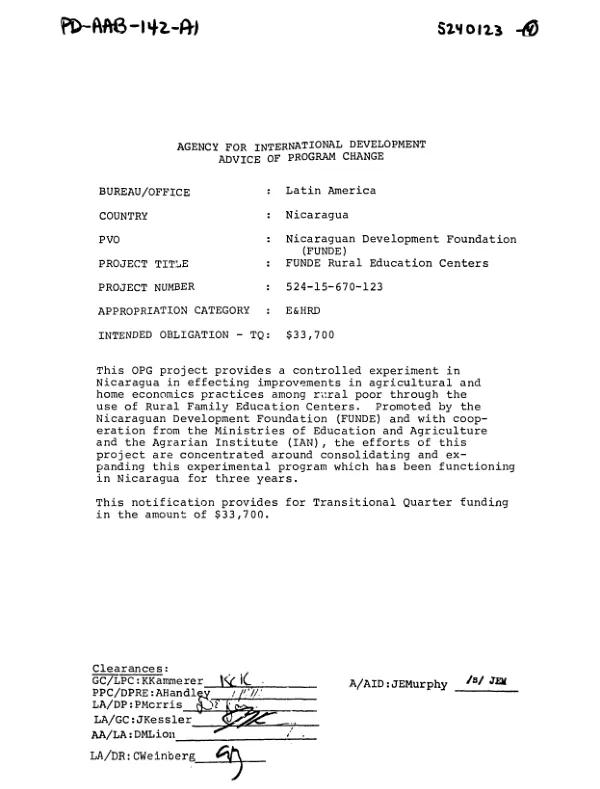
Advice of Program Change: FUNDE Rural Education Centers
The Nicaraguan Development Foundation (FUNDE) Rural Education Centers project aims to improve agricultural and home economics practices among rural poor in Nicaragua.
2010 · 1 pages
Sign in to readA free account is required to download.
Abstract
This project is a controlled experiment that consolidates and expands the existing Rural Family Education Centers program, which has been functioning in Nicaragua for three years. The program is promoted by FUNDE in collaboration with the Ministries of Education and Agriculture and the Agrarian Institute (IAN). The Rural Family Education Centers provide a platform for rural families to acquire knowledge and skills in agricultural and home economics practices. The centers offer training and education to rural families, enabling them to improve their livelihoods and increase their income. The program focuses on consolidating and expanding the existing centers, which will enable more rural families to benefit from the training and education provided. The project is funded by the Agency for International Development (USAID) through the Education and Human Resources Development (E&HRD) appropriation category. The intended obligation for the project is $33,700, which will be used to support the Transitional Quarter funding. The project is expected to have a positive impact on the rural poor in Nicaragua, enabling them to improve their agricultural and home economics practices and increase their income. The Rural Family Education Centers program has been functioning in Nicaragua for three years, and the project aims to build on this existing infrastructure. The program is expected to have a significant impact on the rural poor in Nicaragua, enabling them to improve their livelihoods and increase their income. The project's focus on consolidating and expanding the existing centers will enable more rural families to benefit from the training and education provided. The project's success will depend on the effective implementation of the program, which will require close collaboration between FUNDE, the Ministries of Education and Agriculture, and the Agrarian Institute (IAN). The project's impact will be evaluated through regular monitoring and evaluation, which will enable the project team to identify areas for improvement and make adjustments as needed.
Related documents