COMMUNICATIONS FOR DEVELOPMENT FOUNDATION UGANDA
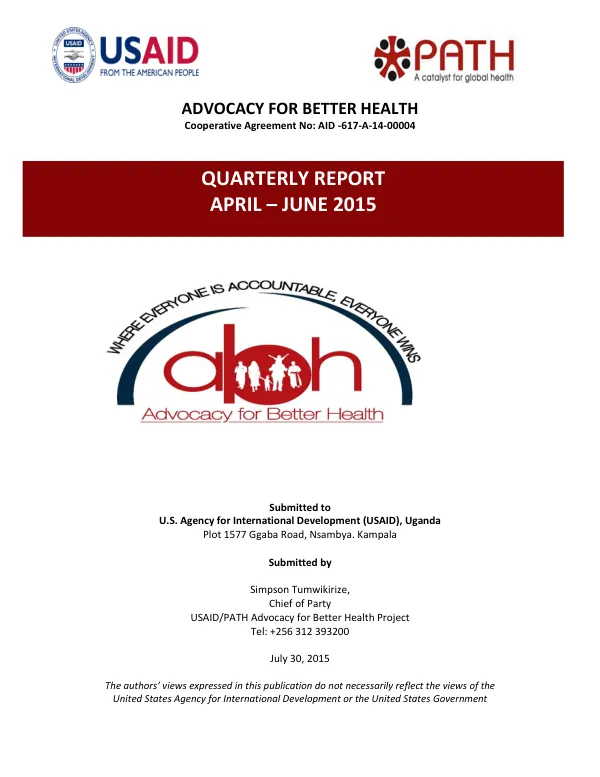
Advocacy for Better Health: Quarterly Report April – June 2015
The Advocacy for Better Health project in Uganda began in 2014 with the goal of improving health and social services through citizen empowerment and advocacy.
2015 · 31 pages
Sign in to readA free account is required to download.
Abstract
The project is funded by the United States Agency for International Development (USAID) and is implemented by PATH. The project's main objective is to strengthen the capacity of civil society organizations (CSOs) to advocate for improved health and social services. The project's approach focuses on building the capacity of CSOs to engage in advocacy and citizen empowerment activities. This includes providing training and technical assistance to CSOs on advocacy and organizational development, as well as supporting them to develop and implement advocacy strategies. The project also works with CSOs to identify priority advocacy issues and develop media messages to promote citizen empowerment and advocacy. In the first year of the project, significant progress was made towards achieving the project's FY 15 targets. The project was on track to achieve its targets for 4 out of 8 performance indicators, with the remaining indicators not having targets to be achieved in FY 15. The project's major challenges include limited understanding and appreciation of the concept of advocacy among CSOs, as well as a lack of willingness to collaborate among CSOs. To overcome these challenges, the project team provided technical assistance to partner CSOs to enhance their proficiency in advocacy, and mobilized CSOs funded by other implementing partners/donors to coordinate advocacy efforts. The project also supported CSOs to develop and roll out advocacy strategies for prioritized issues, and facilitated them to identify community groups, advocacy forums, and other structures for advancing community mobilization and citizen-led advocacy. In the next quarter (July to September 2015), the project team will focus on supporting CSOs to intensify citizen/community empowerment activities related to prioritized advocacy issues, intensifying a media campaign focused on these issues, and coordinating efforts of CSOs to develop a citizens/CSOs manifesto to influence manifestos of various political actors in the upcoming general elections. The project's performance indicators are categorized into three result areas: Result Area 1, which focuses on improving service delivery; Result Area 2, which focuses on strengthening the capacity of CSOs; and Result Area 3, which focuses on promoting citizen empowerment and advocacy. The project's performance indicators include metrics such as the percentage of health facilities that report improvements in service delivery, the percentage of citizens who report having participated in an activity to demand improved health and social services, and the number of CSOs that demonstrate influence on the health and social services agenda. The project's progress is monitored and evaluated through a system of indicators and targets, which are tracked and reported on a quarterly basis. The project's performance is also reviewed and assessed through a system of lessons learned, which identifies best practices and areas for improvement. The project's partnerships and coordination with other stakeholders are critical to its success. The project works closely with CSOs, government agencies, and other implementing partners to ensure that its activities are aligned with national priorities and that its impact is maximized. The project also engages in advocacy and lobbying efforts to influence policy and decision-making processes at the national and local levels. Overall, the Advocacy for Better Health project in Uganda is making significant progress towards its goals of improving health and social services through citizen empowerment and advocacy. The project's focus on building the capacity of CSOs and promoting citizen empowerment and advocacy is critical to its success, and its partnerships and coordination with other stakeholders are essential to ensuring that its activities are aligned with national priorities and that its impact is maximized.
Related documents