USAID
Afya Uzazi: Improving Health & Environment in Nakuru County
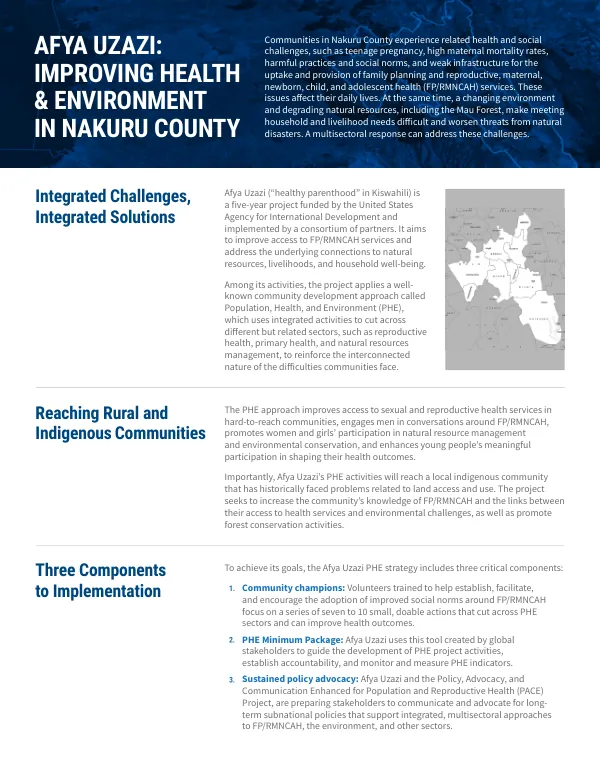
Afya Uzazi is a five-year project implemented in Nakuru County, Kenya, with the goal of improving access to family planning and reproductive, maternal, newborn, child, and adolescent health (FP/RMNCAH) services.
2018 · 2 pages
Sign in to readA free account is required to download.
Abstract
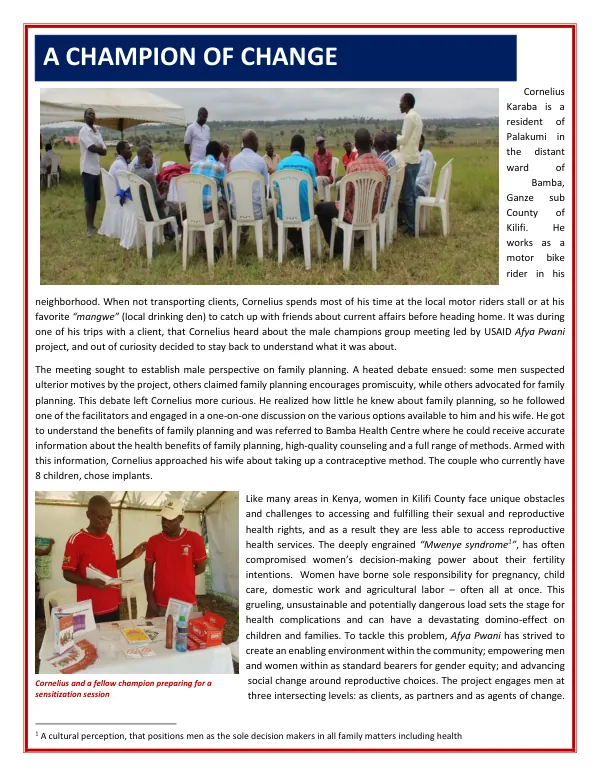
The project aims to address the underlying connections between natural resources, livelihoods, and household well-being. Afya Uzazi is funded by the United States Agency for International Development and implemented by a consortium of partners. The project applies a Population, Health, and Environment (PHE) approach, which integrates activities across different sectors, including reproductive health, primary health, and natural resources management. This approach improves access to sexual and reproductive health services in hard-to-reach communities, engages men in conversations around FP/RMNCAH, promotes women and girls' participation in natural resource management and environmental conservation, and enhances young people's meaningful participation in shaping their health outcomes. Afya Uzazi's PHE activities focus on three critical components: community champions, the PHE Minimum Package, and sustained policy advocacy. Community champions are volunteers trained to help establish, facilitate, and encourage the adoption of improved social norms around FP/RMNCAH. The PHE Minimum Package is a tool created by global stakeholders to guide the development of PHE project activities, establish accountability, and monitor and measure PHE indicators. Sustained policy advocacy involves preparing stakeholders to communicate and advocate for long-term subnational policies that support integrated, multisectoral approaches to FP/RMNCAH, the environment, and other sectors. The project targets a local indigenous community that has historically faced problems related to land access and use. Afya Uzazi seeks to increase the community's knowledge of FP/RMNCAH and the links between their access to health services and environmental challenges, as well as promote forest conservation activities. The project also aims to reach a local indigenous community that has historically faced problems related to land access and use. Afya Uzazi's implementation strategy includes community-based technical working groups and intervention advisory teams that coordinate and monitor PHE activities. These teams enable a research and learning agenda that supports using data in decision-making and capturing lessons learned to inform future interventions. Community forest associations integrate FP and reproductive health service delivery with environment activities such as ecotourism, water harvesting initiatives, tree nurseries, and sustainable income-generating activities. These activities ensure that communities near forests can access FP commodities through health volunteers and PHE promoters. The project also establishes a PHE community of practice and network of champions that includes multisectoral stakeholders from community-based organizations with training on PHE. These organizations represent youth, women, religious groups, and sectors such as health and environment. The champions engage in advocacy for increased PHE scale-up and accountability for healthy and sustainable practices.