PALLADIUM INTERNATIONAL, LLC
USAID Afya Pwani Family Planning Program Brief
The USAID Afya Pwani Family Planning Program was implemented in Kilifi County, Kenya, from 2016 to 2021.
2021 · 8 pages
Sign in to readA free account is required to download.
Abstract
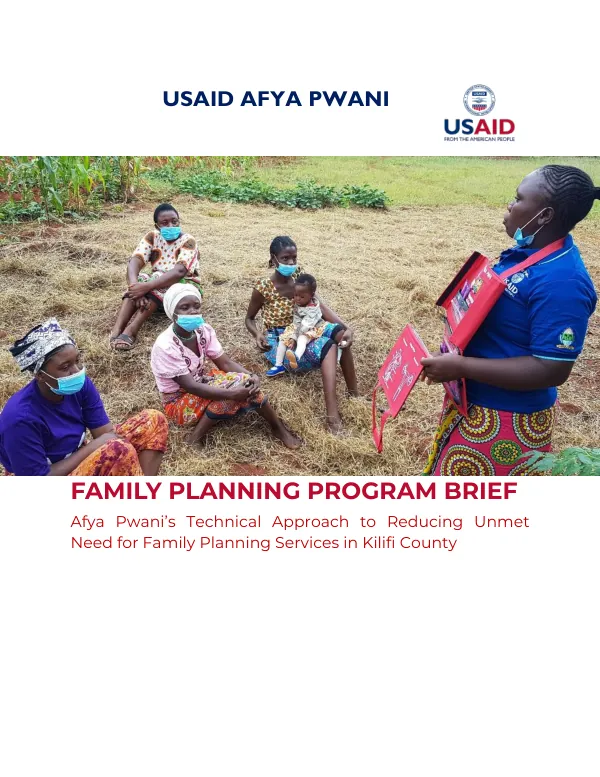
The program aimed to increase demand, access, and quality of voluntary family planning services to improve the modern contraceptive prevalence rate and reduce unmet need among adolescents, youth, and women of reproductive age. The program was led by Pathfinder International in partnership with Palladium and Plan International. The program's technical approach focused on reducing unmet need for family planning services in Kilifi County. The county had a high fertility rate of 5.1, a low modern contraceptive prevalence rate of 33%, and a high unmet need for family planning of 21.8% in 2014. The program identified a wide range of demand-side barriers, including poverty, literacy, and socio-cultural factors, as well as supply-side barriers, such as geographic access to health facilities and inadequate community-facility linkages. To address these barriers, the program implemented several social behavior and change strategies, including advocacy, social mobilization, and behavior change communication. The program engaged local leaders and national administrators to dissuade communities against retrogressive practices and initiated a transformative empowerment approach, "Utawala na Afya," to trigger community-led solutions. The program also expanded discussions and dialogue about family planning among community members through an elaborate network of community-based resource persons, including community-based distributors, male champions, traditional leaders, community-based distributors, and religious leaders. These influencers were trained, sensitized, and equipped with job aids to guide messaging, reaching a cumulative 904,545 people with family planning messages and services at the community level. To increase community-level access to family planning services, the program strengthened community-based distribution, targeted integrated outreach, and door-to-door family planning services. The program also leveraged community events, such as edutainment, sports, community meetings, and public events, to provide family planning services. The program improved the quality of voluntary family planning services by supporting the county to improve service providers' skills and competencies, expand service delivery, improve quality, and strengthen commodity and equipment security. The program conducted a blended capacity-strengthening approach that encompassed face-to-face training, continuous medical education, on-the-job training, structured mentorship, whole-site sensitization, and virtual training. At the facility level, the program trained 106 health care workers on provision of long-acting reversible contraceptives and postpartum family planning methods. The program also sensitized 161 health care providers on commodity forecasting, quantification, documentation, and reporting using the Contraceptive Facility Consumption and Data Report & Request (FCDRR) reporting tool. The program expanded family planning services by integrating them with critical service delivery points, including gynecology outpatient clinics, postpartum clinics, child health clinics, and HIV comprehensive care centers, using the Family Planning High Impact Practices guidance. The program also included family planning services in the group antenatal and postnatal care model and incorporated healthy timing and spacing of pregnancy messages during pre-pregnancy counseling, antenatal care, delivery, and post-pregnancy care. The program strengthened family planning integration in 60 comprehensive care centers and institutionalized postpartum family planning in maternity and postnatal clinics. The program enhanced the continuum of care using a holistic approach to healthy timing and spacing of pregnancy in Group ANC and PNC, commonly known as Mama Kwa Mama and Binti Kwa Binti groups. These groups were vital avenues to integrate clinical services with tailored group educational activities and peer support, which boosted retention in care, improved maternal and child health outcomes, and increased uptake of family planning.
Related documents