USAID DEC
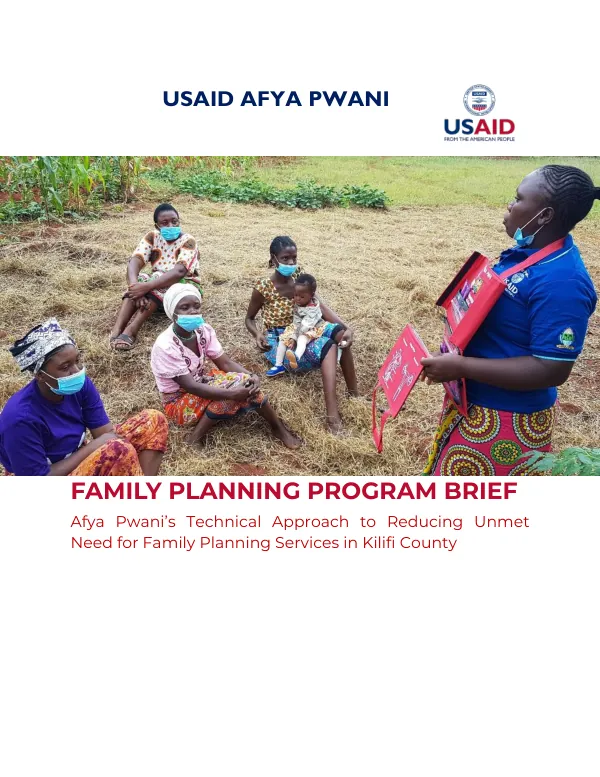
Empowering Men and Women in Kilifi County to Improve Reproductive Health and Nutrition
Sign inUSAID
Empowering Men and Women in Kilifi County to Improve Reproductive Health and Nutrition
Cornelius Karaba is a resident of Palakumi in the distant ward of Bamba, Ganze sub County of Kilifi.
2021 · 54 pages
Sign in to readA free account is required to download.
Abstract
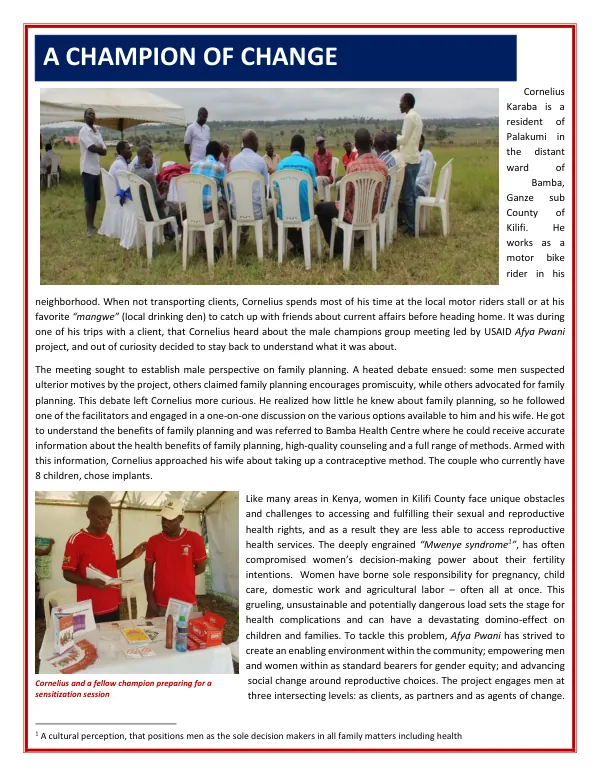
He works as a motor bike rider in his neighborhood. When not transporting clients, Cornelius spends most of his time at the local motor riders stall or at his favorite "mangwe" (local drinking den) to catch up with friends about current affairs before heading home. It was during one of his trips with a client that Cornelius heard about the male champions group meeting led by USAID Afya Pwani project, and out of curiosity decided to stay back to understand what it was about. The meeting sought to establish male perspective on family planning. A heated debate ensued: some men suspected ulterior motives by the project, others claimed family planning encourages promiscuity, while others advocated for family planning. This debate left Cornelius more curious. He realized how little he knew about family planning, so he followed one of the facilitators and engaged in a one-on-one discussion on the various options available to him and his wife. He got to understand the benefits of family planning and was referred to Bamba Health Centre where he could receive accurate information about the health benefits of family planning, high-quality counseling, and a full range of methods. Armed with this information, Cornelius approached his wife about taking up a contraceptive method. The couple, who currently have 8 children, chose implants. Like many areas in Kenya, women in Kilifi County face unique obstacles and challenges to accessing and fulfilling their sexual and reproductive health rights, and as a result, they are less able to access reproductive health services. The deeply ingrained "Mwenye syndrome" has often compromised women's decision-making power about their fertility intentions. Women have borne sole responsibility for pregnancy, child care, domestic work, and agricultural labor – often all at once. This grueling, unsustainable, and potentially dangerous load sets the stage for health complications and can have a devastating domino-effect on children and families. To tackle this problem, Afya Pwani has strived to create an enabling environment within the community; empowering men and women within as standard bearers for gender equity; and advancing social change around reproductive choices. The project engages men at three intersecting levels: as clients, as partners, and as agents of change. Afya Pwani has trained 157 male champions in Kilifi County, including Cornelius, to increase reproductive health awareness among men, improve spousal communication on issues of sexuality, reproductive health, and family planning, as well as encourage couple counseling for FP services. Through community forums, meetings, and informal opportunities like the "mangwe get togethers," over 10,000 men have been reached with messages on family planning. As a result of these outreach activities, 1,570 men have taken the lead and accompanied their wives for FP services, a norm that was unheard of in Kilifi County. The male champions also report a growing number of men allowing their wives to take up contraceptives. Convinced of the growing positive outcomes of the male champions' involvement, Matron Esther Mwema, Kilifi County Reproductive Health (RH) Coordinator, officially adopted the concept from Afya Pwani, giving a directive for all sub-counties in the county to train and mentor RH male champions. Mwema says, "Lately, we are seeing more men accompanying their wives when they come in for family planning, this is very encouraging and as such, we must scale it up across the entire County." The Contraceptive Prevalence Rate in Kilifi County has now significantly increased from 32% (KDHS 2014) before Afya Pwani began, to 42.9% in 2018, according to a survey by PMA 2020. In discussing family planning with his wife, Cornelius learned that she always wanted to delay pregnancies but couldn't talk about it out of fear that he could divorce her. "That statement left me feeling like a monster, because I often pushed her to give me more children," says Cornelius remorsefully. His experience underscores the difficulty many women face in talking with their spouses and partners about their desire to plan their families in a safe and healthy manner. But now, through the education and support efforts of Afya Pwani, many couples are jointly deciding what's best for their family. "It is our duty as men to ensure that our families are healthy and happy, and that can only be achieved through talking about family planning and jointly making informed decisions," says Cornelius confidently. Afya Pwani has also empowered men to take a more active role in their families' health and well-being. Hamisi, a 34-year-old man from Kombani, is one such example. He had a troubled past, struggling with addiction and living a neglected life after his parents passed away. However, with the support of the USAID Afya Pwani project, Hamisi was able to overcome his
Related documents