BOOZ, ALLEN AND HAMILTON, INC.
AgCLIR Lessons From the Field: Closing a Business
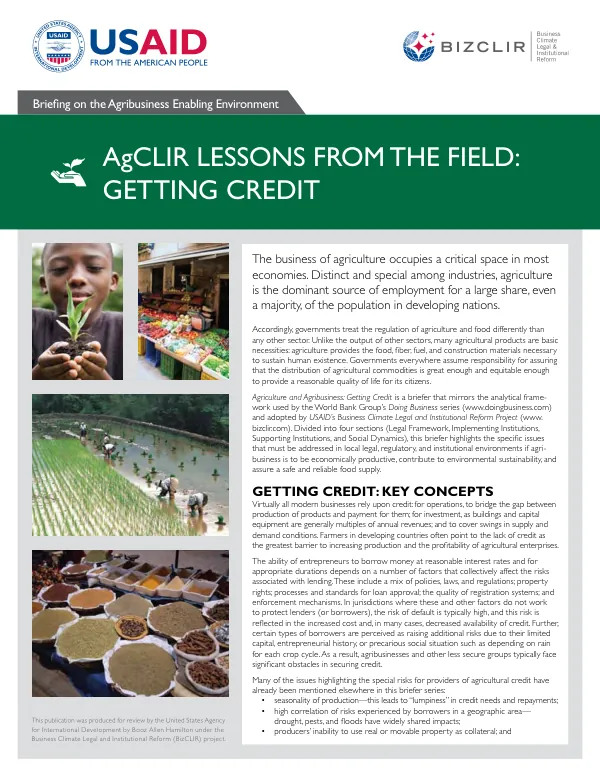
The agricultural business sector in developing countries is characterized by a high level of employment and a dominant source of basic necessities such as food, fiber, fuel, and construction materials.
2009 · 4 pages
Sign in to readA free account is required to download.
Abstract
Governments assume responsibility for ensuring the distribution of agricultural commodities is sufficient and equitable to provide a reasonable quality of life for citizens. The regulation of agriculture and food is distinct and special among industries, with many agricultural products being basic necessities. Agriculture and Agribusiness: Closing a Business is a briefing that mirrors the analytical framework used by the World Bank Group's Doing Business series and adopted by USAID's Business Climate Legal and Institutional Reform Project. The briefing highlights the specific issues that must be addressed in local legal, regulatory, and institutional environments if agribusiness is to be economically productive, contribute to environmental sustainability, and assure a safe and reliable food supply. The briefing is divided into four sections: Legal Framework, Implementing Institutions, Supporting Institutions, and Social Dynamics. The process of closing a business in the agricultural sector is often complicated by the need to consider public health and environmental liabilities, as well as the essential nature of the product or service provided. In some cases, governments may intervene directly to prevent bankruptcy and the closing of the business, particularly when the company in question holds a monopoly position or has been grossly negligent. The briefing notes that bankruptcy law provides a predetermined set of rules concerned with the legal definition of insolvency, the liquidation or reorganization of the insolvent business, and the allocation of financial consequences between stakeholders. Bankruptcy law generally provides two options for firms facing insolvency: liquidation or rehabilitation. Either option can be entered into voluntarily by the company owners or initiated by creditors. The law establishes the priority of creditors' interests, as well as other types of expenses or debts. USAID recommends that countries enact a single bankruptcy law to cover all enterprises or corporate entities other than financial institutions and insurance companies. The law should cover the commencement of process, creditors' involvement and treatment, the role of the court, corporate reorganization, corporate liquidation, and criminal provisions. Implementing institutions play a crucial role in the process of closing or reorganizing a business under rules governing bankruptcies. Judicial institutions, financial institutions, and specialized organizations and consultants dealing with business work-out and reorganization are involved in the process. In addition, bankruptcies may involve a special insolvency agency rather than a court. At the company level, the appointment of administrators or trustees and liquidators is common. The administrators or trustees are designated to handle either the rehabilitation or the liquidation of the enterprise and are accountable to the court or agency with jurisdiction over insolvency cases. Supporting institutions, such as court officers, lawyers, and professional associations, are essential for addressing the needs of bankruptcy constituencies and promoting the effectiveness of the bankruptcy system as a whole. Extension services provide education and information that can help agribusinesses understand and initiate bankruptcy proceedings as needed. Business advisors or consultants can provide the company and its appointed administrators with the advice needed to determine whether liquidation or reorganization is the best way to close the business. Financial institutions wishing to expand agribusiness lending portfolios are perhaps most aware of the need for bankruptcy law and regulation as it underlies their abilities to recover assets in lieu of credit repayment. The failure of state trading enterprises, parastatal production units, or state-managed "cooperative" apex organizations has probably had a larger impact on the majority of agricultural enterprises. Governments have often intervened to forestall an orderly process of liquidation or reorganization of such entities in the interests of consumers, corrupt but well-connected political figures, or an inability to agree on the appropriate state role regarding these entities.
Related documents