ICF
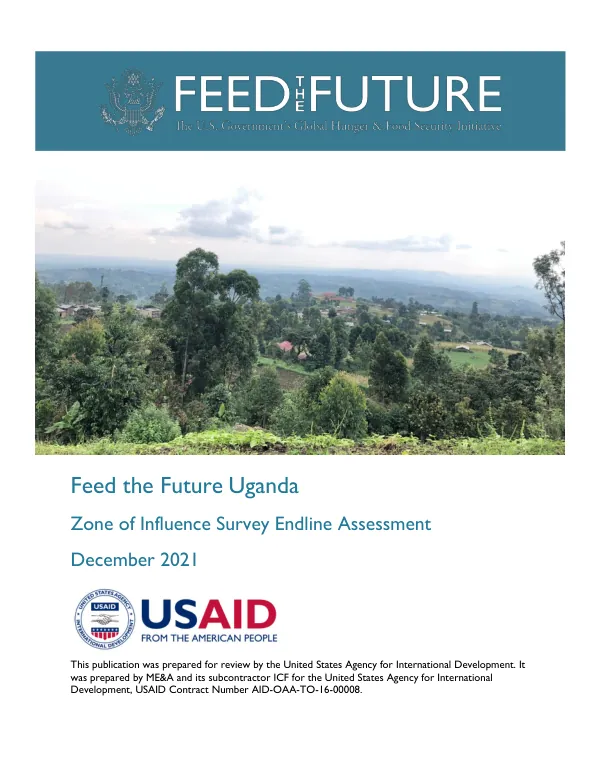
Feed the Future Uganda: Zone of Influence Survey Endline Assessment
Feed the Future Uganda Zone of Influence Phase One Endline Assessment was conducted in December 2021.
2021 · 176 pages
Sign in to readA free account is required to download.
Abstract
The assessment aimed to evaluate the progress of the Feed the Future Uganda Zone of Influence (ZOI) program, which was implemented from 2018 to 2021. The program was funded by the United States Agency for International Development (USAID) and implemented by ME&A and its subcontractor ICF. The ZOI program focused on improving agricultural productivity, income, and food security for smallholder farmers in Uganda. The program targeted 10 districts in the country, with a total population of approximately 1.2 million people. The program's interventions included farmer training, infrastructure development, and market linkage facilitation. The assessment used a range of indicators to evaluate the program's impact, including household economic status, women's empowerment in agriculture, household hunger and dietary intake, and nutritional status of women and children. The assessment found that the program had a positive impact on household economic status, with a 27% increase in daily per capita consumption expenditures among program participants compared to the control group. The assessment also found that the program had a positive impact on women's empowerment in agriculture, with significant improvements in women's participation in decision-making and control over resources. The program also had a positive impact on household hunger and dietary intake, with a 25% reduction in household hunger and a 15% increase in women's dietary diversity. In terms of nutritional status, the assessment found that the program had a positive impact on the nutritional status of women and children. The program resulted in a 10% reduction in stunting among children under 5 years of age and a 5% reduction in wasting among children under 5 years of age. The assessment concluded that the Feed the Future Uganda Zone of Influence program had a positive impact on the lives of smallholder farmers in Uganda, particularly women. The program's interventions had a significant impact on household economic status, women's empowerment in agriculture, household hunger and dietary intake, and nutritional status of women and children. The assessment recommended that the program's interventions be scaled up and replicated in other parts of the country to reach more smallholder farmers. The assessment used a range of data sources, including baseline and endline surveys, to evaluate the program's impact. The data sources included household surveys, focus group discussions, and key informant interviews. The assessment also used a range of indicators, including the Agricultural Women's Empowerment Index (A-WEAI), to evaluate the program's impact on women's empowerment in agriculture. The assessment found that the program had a positive impact on the A-WEAI, with significant improvements in women's participation in decision-making and control over resources. The program also had a positive impact on the A-WEAI's production, resources, income, leadership, and time domains. The assessment concluded that the program's interventions had a significant impact on women's empowerment in agriculture and recommended that the program's interventions be scaled up and replicated in other parts of the country to reach more women. The assessment also found that the program had a positive impact on the nutritional status of women and children. The program resulted in a 10% reduction in stunting among children under 5 years of age and a 5% reduction in wasting among children under 5 years of age. The assessment concluded that the program's interventions had a significant impact on the nutritional status of women and children and recommended that the program's interventions be scaled up and replicated in other parts of the country to reach more women and children.