AFGHANISTAN MINISTRY OF AGRICULTURE, IRRIGATION AND LIVESTOCK
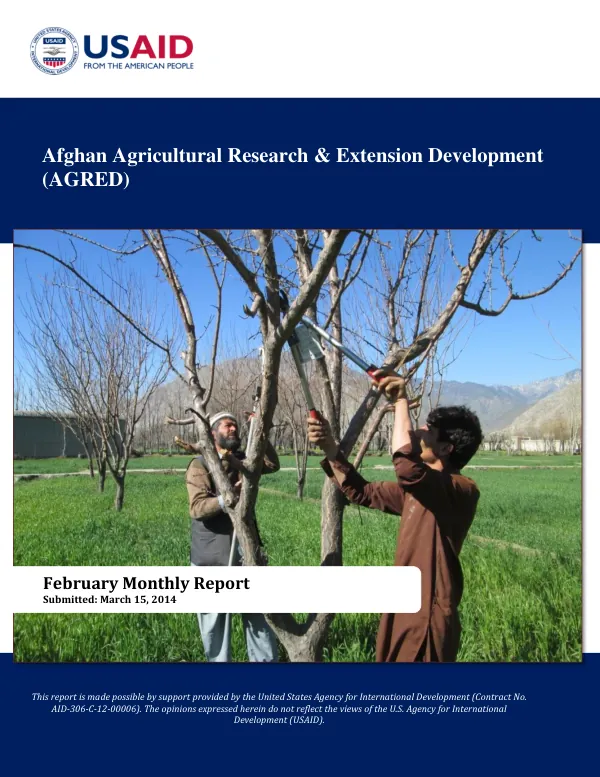
AGRED Monthly Report- February 2014
Afghan Agricultural Research and Extension Development (AGRED) is a five-year program in partnership with the Afghan Ministry of Agriculture, Irrigation and Livestock (MAIL) and provincial-level Directorates of Agriculture, Irrigation and Livestock (DAILs).
2014 · 23 pages
Sign in to readA free account is required to download.
Abstract
The program aims to increase agricultural productivity and income through the application of science and technology. AGRED's overarching objective is to build enduring and effective research and extension systems. AGRED's services are delivered through its Research, Extension, Training, and Gender technical departments. The technical teams are supported by Monitoring and Evaluation (M&E), Communications, Human Resources, Information Technology (IT), and Senior Management departments. The program's services are directed by two general results: delivering services directly to Afghan farmers through improved research and extension efforts, and building institutional and human capacities within MAIL and DAILs to help improve their ability to respond to farmers' and herders' needs. AGRED's target provinces and districts include several regions in Afghanistan. The program's services are designed to improve farmer awareness and access to improve technologies, knowledge, and education; improve research and extension infrastructure within MAIL and DAILs; improve training capacity within MAIL and DAILs to deliver to farmers; and institutionalize a bottom-up, consultative approach to identifying and addressing farmers' needs. AGRED has introduced a revised field reporting template and system for collecting field-level data. The revised templates aim to better standardize, isolate, and polish information for presentation to USAID and other stakeholders. The program has also procured the equipment necessary to collect GPS points, which is anticipated to be introduced in next month's report. AGRED's collaboration efforts for February focused on moving closer to formalizing relationships through MOUs with the Japan International Cooperation Agency (JICA), International Maize and Wheat Improvement Center (CIMMYT), and making initial steps with Mercy Corps, Plantwise, and Afghanistan Institutional Development (AFID) project. Additionally, AGRED ensured that MAIL management teams were updated on the status of its Work Plan. AGRED's Technical Support Delivered section highlights several key activities, including on-farm training, farmer field schools, exposure visits, extension visits, and research trials. The program's Expected Results include more effective communication with Afghan farmers, improved applied research and extension infrastructure, training and capacity building of MAIL/DAIL extension staff, and applied research and extension grants. AGRED's services are delivered through its Research, Extension, Training, and Gender technical departments, with support from Monitoring and Evaluation, Communications, Human Resources, Information Technology, and Senior Management departments. AGRED's institutional strengthening efforts aim to build the capacity of MAIL and DAILs to respond to farmers' and herders' needs. The program's training and capacity building activities focus on improving the skills and knowledge of MAIL and DAIL extension staff. AGRED's research and extension infrastructure development efforts aim to improve the capacity of MAIL and DAILs to deliver services to farmers. The program's applied research and extension grants aim to support research and extension activities that address the needs of Afghan farmers and herders. AGRED's monitoring and evaluation efforts aim to track the program's progress and impact. The program's communications efforts aim to disseminate information about AGRED's activities and achievements to stakeholders. AGRED's administrative support efforts aim to ensure the effective management of the program.
Related documents