AFGHANISTAN MINISTRY OF AGRICULTURE, IRRIGATION AND LIVESTOCK
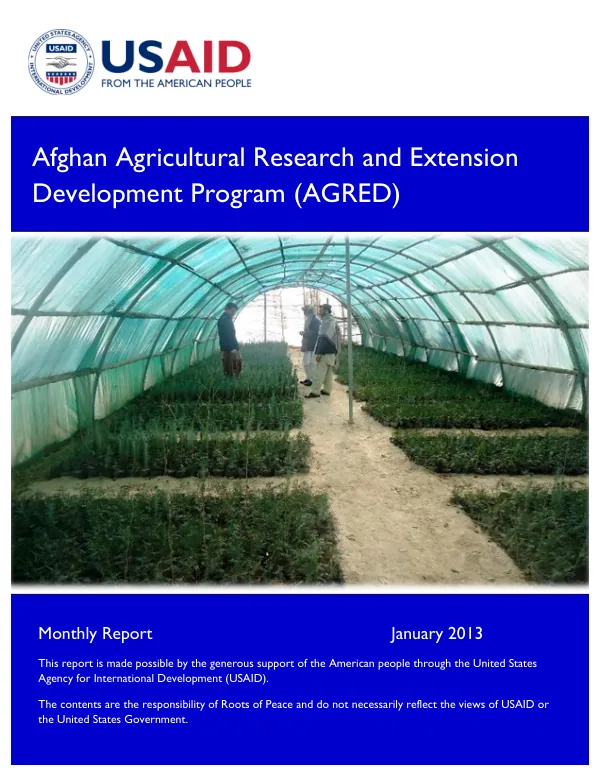
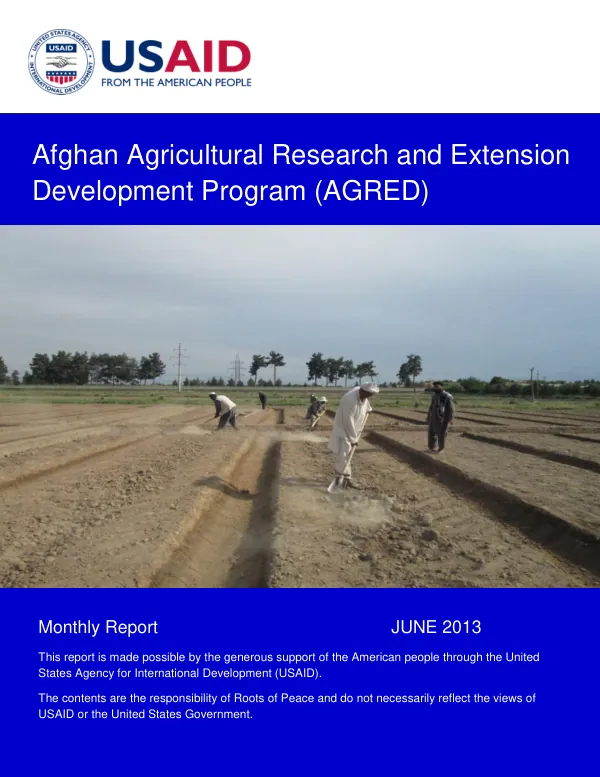
AGRED Monthly Report - June 2013
Afghan Agricultural Research and Extension Development Program (AGRED) was established in 2012 with a contract award of $23,638,611 from the United States Agency for International Development (USAID).
2013 · 22 pages
Sign in to readA free account is required to download.
Abstract
The program is implemented by Roots of Peace (ROP) and aims to improve agricultural research and extension services in Afghanistan. The program is led by Chief of Party Herschel Weeks, PhD, and is supported by a team of experts in agricultural research and extension. During the month of June 2013, AGRED held a number of high-level meetings on the MAIL Implementation Plan, including a Partners Meeting between MAIL and USAID. The Partners Meeting addressed alignment with the On-budget Implementation Plan and the World Bank Capacity Building for Results program. AGRED has been working closely with MAIL departments to incorporate MAIL and USAID inputs into the On-Budget Implementation Plan. The goal of this integrated document is to create a set of indicators and benchmarks that are aligned with MAIL objectives. AGRED also launched the Women in Agriculture Working Groups in June, which will help Women Regional Extension Coordinators to gather stakeholders and discuss the needs of women farmers and herders. The working groups will meet on a monthly basis. The research and extension field team continues to work closely with DAILs on mini-proposal development and project implementation. The first of the mini-proposals, the Herat Wheat Trial, is nearing completion with the first harvest of the trial in the coming month. AGRED staff participated in trainings on conservation agriculture and Integrated Pest Management (IMP) organized by the USDA AAEP program. The EC PHDP program and the Aga Khan Foundation (AKF) also invited AGRED staff to participate in research trainings. These trainings are beneficial to the program and to DAILs as they decrease duplication in the trainings provided and ensure that best practices are being communicated uniformly. AGRED's priorities for the month of June included the implementation of approved mini-projects, such as wheat seed cultivation trails, cultivation of new and improved commercial grape varieties, and establishment of a grape vineyard. The program also conducted meetings with USAID and PRT/ADT representatives, as well as coordination meetings with MAIL and DAIL. The Deputy Director of OAG will serve as alternate COR until a full-time replacement arrives in the coming months.
Related documents