FEED THE FUTURE
Agricultural Insurance
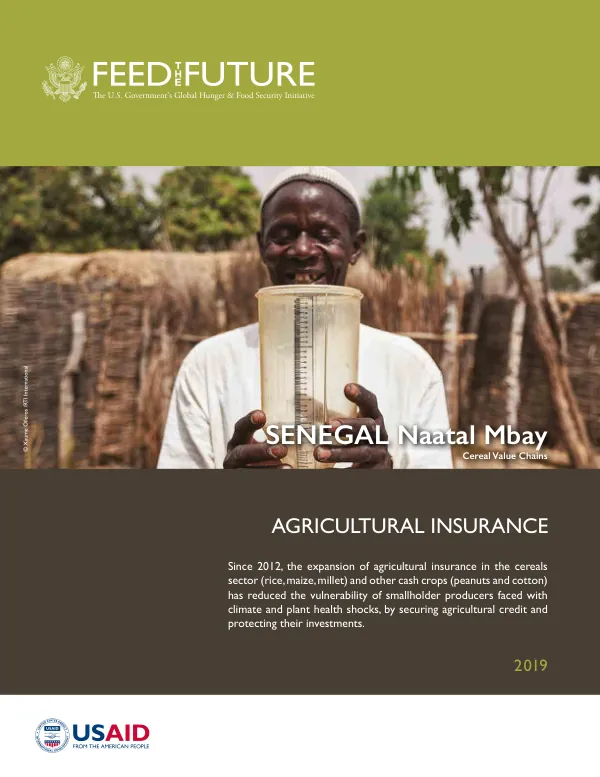
The expansion of agricultural insurance in Senegal has significantly reduced the vulnerability of smallholder producers to climate and plant health shocks.
2019 · 12 pages
Sign in to readA free account is required to download.
Abstract
Since 2012, the Senegal National Agricultural Insurance Company (CNAAS) has been providing insurance solutions tailored to the cereals sector, including rice, maize, millet, peanuts, and cotton. The company's early years were marked by an effort to sensitize rural clients and develop a diversified service offering with the support of technical and financial partners. CNAAS' proposed agricultural insurance for cereal producers is divided into two separate formulas: conventional agricultural insurance ("multi-risk") and index-based agricultural insurance. Conventional agricultural insurance is intended for the irrigated rice value chain in the Senegal River Valley, while index-based agricultural insurance is adapted to the rainfed production system in central and southern Senegal. The risks covered by conventional agricultural insurance include attacks from birds and other pests, floods, and unseasonal rains, while index-based agricultural insurance focuses on rainfall deficits during the crucial phases of crop evolution. The calculation of indices by zone makes it possible to cover a large population, and CNAAS' definition and annual update of the indices integrate the contributions of agricultural research, weather forecasting services, and specialized brokerage services for microinsurance and re-insurance. The company's definition of insured value and number of insured producers has increased significantly since 2012, with a total of 193,000 producers insured in 2018, covering 238,000 hectares of crops. The adoption of index-based insurance by cereal producers not covered by Feed the Future, the cotton sector, and peanut producers has led to an exponential growth of CNAAS' agricultural portfolio since 2016. The performance of cereal value chains has facilitated significant qualitative changes in value chain practices through awareness raising, training, and capacity building for insurance stakeholders. Producers agree to pay the insurance premium, although they receive a 50 percent subsidy from the Government of Senegal, and the proportion of producers who paid their share of the premium reached 92 percent in 2018. Financial institutions are gradually incorporating agricultural insurance into producer credits, allowing producers to improve their credit report with a guarantee against climatic risks. Producer networks and companies are also serving as distribution partners for CNAAS, facilitating access to insurance for smallholder producers. The expansion of agricultural insurance in Senegal has paved the way for transforming agriculture, making it more resilient to climate and plant health shocks.
Related documents