RTI INTERNATIONAL
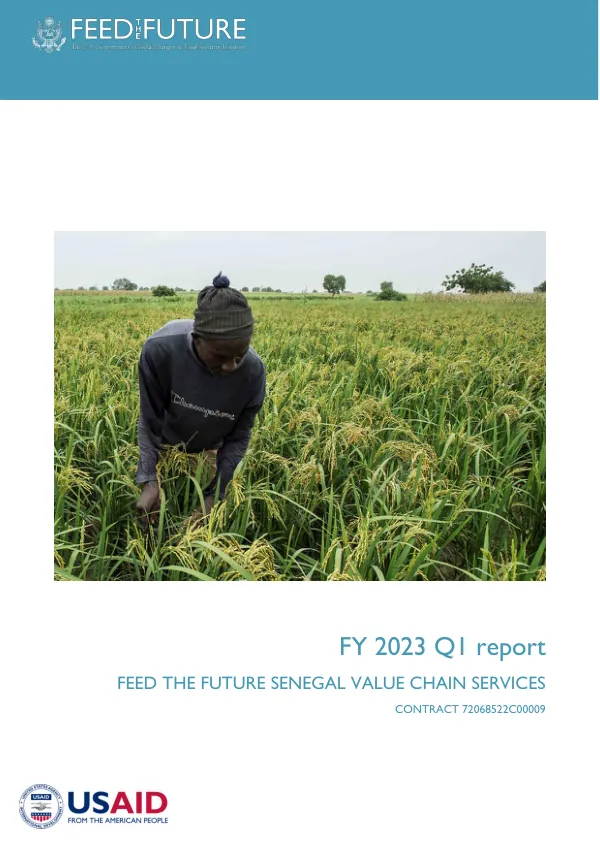
FY 2023 Quarter 1 Report FEED THE FUTURE SENEGAL VALUE CHAIN SERVICES
The Feed the Future Senegal Value Chain Services program aims to improve the productivity and resilience of smallholder farmers in Senegal.
2023 · 51 pages
Sign in to readA free account is required to download.
Abstract
The program focuses on three main components: Smallholder Productivity along the Value Chain, Employment and Enterprise Development in Key Food Value Chains, and Access to Markets and Trade. These components are designed to increase the income and food security of smallholder farmers, as well as improve their access to markets and trade. The program has made significant progress in its first quarter of implementation. Smallholder farmers have increased their adoption of technologies and services that enhance their productivity, such as composting and crop rotation. Additionally, farmers have gained access to productive resources, including land, water, and energy. The program has also improved the infrastructure and equipment of farmers, including farm mechanization and post-harvest equipment. Employment and Enterprise Development in Key Food Value Chains has also seen significant progress. Micro, Small, and Medium Enterprises (MSMEs) have increased their access to business development services, and farmers have gained entrepreneurial, managerial, and technical skills. The program has also expanded and improved access to finance for farmers, particularly for women and youth. Access to Markets and Trade has also improved, with increased market linkages between stakeholders in the value chain. The program has also increased the capacities of value chain stakeholders to meet market demands. The program has also implemented activities to improve the resilience of farmers, reduce the impact of increased fertilizer costs, and introduce effective practices and technologies. The program has also implemented cross-cutting activities, including Improved Business Environment for MSMEs, Enhanced Risk Management, and Increased Women and Youth Economic Empowerment. These activities aim to improve the business environment for MSMEs, enhance the risk management capacities of farmers, and increase the economic empowerment of women and youth. The program has also implemented a Monitoring, Evaluation, and Learning Plan (AMELP) to track its progress and identify areas for improvement. The program has also established a data collection and management system to monitor its activities and outcomes. The program has also implemented a communication strategy to communicate its activities and outcomes to stakeholders. The program has also developed branding and marketing materials to promote its activities and outcomes. The program has also launched a website and social media platforms to communicate its activities and outcomes to stakeholders. The program has also implemented an Environmental Mitigation and Monitoring Plan to mitigate the environmental impact of its activities. The program has also established a local capacity development and exit strategy plan to ensure the sustainability of its activities. The program has made significant progress in its first quarter of implementation, and it is expected to continue making progress in the coming quarters. The program's activities and outcomes are expected to improve the productivity and resilience of smallholder farmers in Senegal, as well as improve their access to markets and trade. The program's cross-cutting activities are expected to improve the business environment for MSMEs, enhance the risk management capacities of farmers, and increase the economic empowerment of women and youth. The program's monitoring, evaluation, and learning plan is expected to track its progress and identify areas for improvement. The program's communication strategy is expected to communicate its activities and outcomes to stakeholders, and the program's branding and marketing materials are expected to promote its activities and outcomes. The program's website and social media platforms are expected to communicate its activities and outcomes to stakeholders. The program's environmental mitigation and monitoring plan is expected to mitigate the environmental impact of its activities, and the program's local capacity development and exit strategy plan is expected to ensure the sustainability of its activities. The program's activities and outcomes are expected to improve the productivity and resilience of smallholder farmers in Senegal, as well as improve their access to markets and trade. The program's cross-cutting activities are expected to improve the business environment for MSMEs, enhance the risk management capacities of farmers, and increase the economic empowerment of women and youth. The program's monitoring, evaluation, and learning plan is expected to track its progress and identify areas for improvement. The program's communication strategy is expected to communicate its activities and outcomes to stakeholders, and the program's branding and marketing materials are expected to promote its activities and outcomes. The program's website
Related documents