FEED THE FUTURE
Contracting in Cereal Value Chains: Feed the Future Senegal Naatal Mbay
The agricultural development initiative in Senegal, known as Naatal Mbay, aimed to strengthen cereal value chains and improve the livelihoods of smallholder farmers.
2019 · 12 pages
Sign in to readA free account is required to download.
Abstract
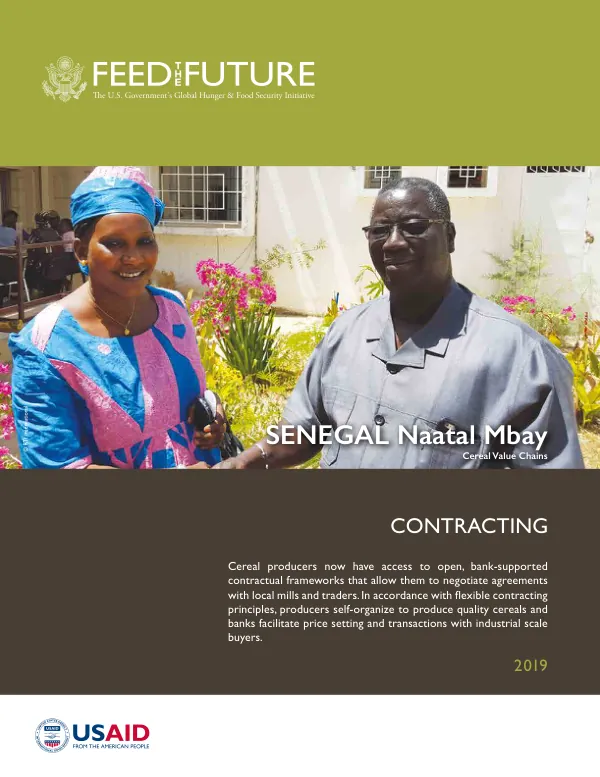
The project was implemented by Feed the Future, a US government initiative, in collaboration with the Government of Senegal and other stakeholders. Historically, contracting in Senegal was associated with large-scale processing and export sectors, where para-governmental or private organizations facilitated access to inputs, technical supervision, and marketing activities. However, these models operated in markets with limited informal trade, and smallholder farmers faced significant challenges in accessing markets and stabilizing prices. The traditional marketing framework for cereals in Senegal is dominated by the informal market, with prices fluctuating significantly throughout the harvest season. This has led to difficulties in organizing marketing and stabilizing prices, with tripartite agreements between buyers, banks, and producer organizations showing limited success. In response to these challenges, Feed the Future's Naatal Mbay project aimed to reinvent the contractual framework between buyers and smallholder producers in the context of the local cereals market. The project promoted a new contracting model that allows producers to self-organize, define their own rules, and ensure that their members follow these rules. The contractual framework promoted by Feed the Future is based on guiding principles that govern capacity building activities and guide stakeholders towards the joint creation of resilient contractual structures. Key components of this framework include producer group self-organization, split contracting of production, formulas for establishing selling prices, autonomous management of seasonal credit and risk coverage, quality standards defined by agreement between the parties, and contracting the provision of services. The project has led to the emergence, stabilization, and scaling-up of new contracting models in the rice, maize, and millet value chains. In the millet value chain, producer networks have strengthened their productive, organizational, and managerial capacity, managing a variety of financing arrangements and adopting index-based agricultural insurance. In the maize value chain, producer networks have negotiated their own fertilizer supply, managed annual bank loans, and negotiated insurance policy distribution agreements. In the irrigated rice value chain, the contracting system has made it possible to structure the raw material supply from producer networks in the Senegal River Valley and from Anambé. The capacity building and facilitation actions of Feed the Future's programs in Senegal have led to significant changes in the contracting models used by smallholder farmers. Producer networks are now able to manage their own finances, negotiate with buyers, and access markets more effectively. The project has also led to the emergence of new business models, with producer networks obtaining a price level that values the quality of their products and being involved in the logistics of batch consolidation on behalf of buyers. The Naatal Mbay project has demonstrated the potential of a new contracting model to improve the livelihoods of smallholder farmers in Senegal. By promoting producer self-organization, autonomous management of seasonal credit and risk coverage, and quality standards defined by agreement between the parties, the project has created a more resilient and competitive value chain. The project's success has also highlighted the importance of capacity building and facilitation in supporting the development of smallholder farmers and improving their access to markets.