USAID DEC
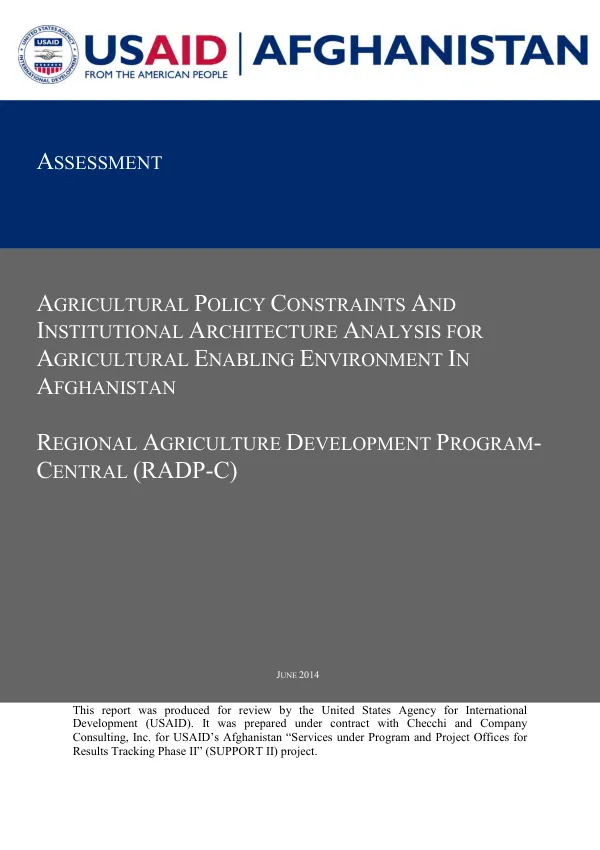
Agricultural Policy Constraints and Institutional Architecture Analysis for Agricultural Enabling Environment in Afghanistan
Sign inCHECCHI AND COMPANY, CONSULTING, INC.
Agricultural Policy Constraints and Institutional Architecture Analysis for Agricultural Enabling Environment in Afghanistan
The agricultural policy constraints and institutional architecture analysis for the agricultural enabling environment in Afghanistan was conducted by Checchi and Company Consulting, Inc.
2014 · 180 pages
Sign in to readA free account is required to download.
Abstract
under contract with the United States Agency for International Development (USAID) for the Afghanistan "Services under Program and Project Offices for Results Tracking Phase II" (SUPPORT II) project. The analysis aimed to identify the current policies or absence of policies that are most detrimental or limiting to Afghan farmers, as well as the structural and organizational factors that shape the creation and implementation of effective policies. The study was conducted in two phases: an environmental scan and identification of priority needs, and an in-depth investigation of policy response to a key priority need. The analysis revealed that the farming context in Afghanistan is characterized by tenuous livelihoods, with farmers facing significant challenges in accessing markets, inputs, and services. The study identified several priority concerns, including the lack of effective policies and institutions to support agricultural development, inadequate access to credit and inputs, and limited market opportunities. The analysis also examined the formal policy and its implementation, including the policy process in Afghanistan, which is characterized by a complex and fragmented institutional architecture. The study found that the challenges in policy implementation lie not only with the policies themselves but also with the way they are implemented, and that structural and organizational factors, such as the lack of coordination and communication among stakeholders, contribute to the limitations of effective policy creation and implementation. The study identified several key actors in policymaking and policy implementation for agricultural markets, including the Ministry of Agriculture, Irrigation, and Livestock (MAIL), the Ministry of Commerce and Industry (MOCI), and the Afghanistan Chamber of Commerce and Industry (ACCI). The analysis also highlighted several policy issues and associated themes, including the need for more effective policies and institutions to support agricultural development, improved access to credit and inputs, and enhanced market opportunities. The study concluded that the creation and implementation of effective policies require a more coordinated and inclusive approach, involving all stakeholders, including farmers, traders, and policymakers. The analysis recommended several actions to address the policy constraints and institutional architecture challenges, including the development of a more effective policy framework, improved coordination and communication among stakeholders, and enhanced capacity building for policymakers and farmers. The study was conducted in collaboration with the Regional Agriculture Development Program-Central (RADP-C) and involved a range of research instruments and interview protocols, including focus group discussions (FGDs), key informant interviews (KIs), and surveys. The study's findings and recommendations are intended to inform policy and programming decisions to support agricultural development in Afghanistan.