USAID DEC
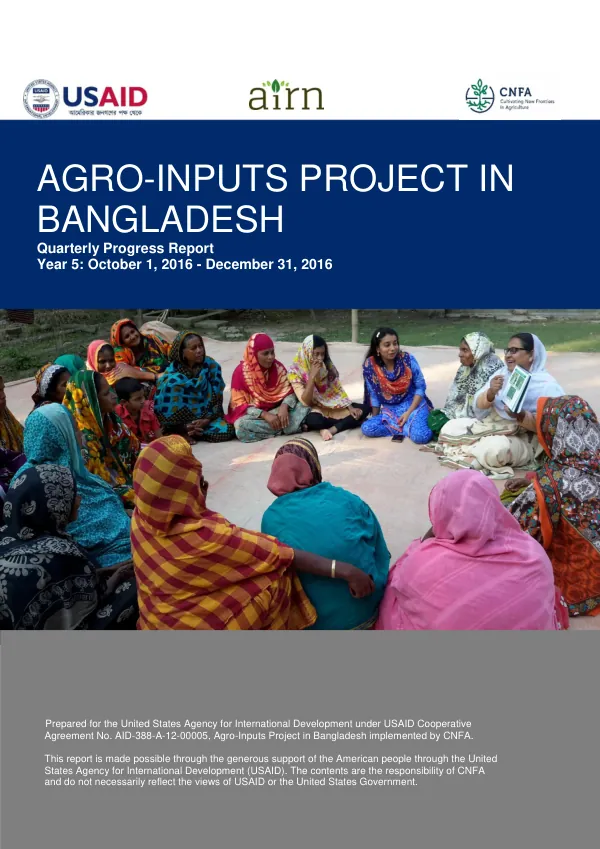
Agro-Inputs Project in Bangladesh: Quarterly Progress Report Year 5, Quarter 1: October 1, 2016-December 31, 2016
Sign inCNFA, INC.
Agro-Inputs Project in Bangladesh: Quarterly Progress Report Year 5, Quarter 1: October 1, 2016-December 31, 2016
The Agro-Inputs Project in Bangladesh is a five-year initiative implemented by CNFA, with funding from the United States Agency for International Development (USAID).
2016 · 32 pages
Sign in to readA free account is required to download.
Abstract
The project aims to improve the supply of quality agricultural inputs through input retailers. The central effort of the project is the creation of a sustainable Agro Input Retailers Network (AIRN) through Intervention 1. AIRN is a first-of-its-kind agro-inputs training organization serving retailers in the Feed the Future (FTF) zone. The network has been established to provide high-quality technical training and advisory services to agro-input dealers. As of this quarter, AIP has trained and accredited 90% of its targeted members, with 2,782 out of 3,103 members receiving training. Interventions 2-4 are designed to work in concert with Intervention 1 and aim to improve the effectiveness of agricultural inputs market information systems, enhance knowledge and application of quality standards, and strengthen local organizations' institutional capacity. Intervention 2 involves the distribution of 115,000 hard copy Monthly Price Outlook Bulletins (MPOB), supported by an innovative Geographic Information System (GIS)-based input market information system (MIS). The demand for improved quality inputs is also being created through 500 demonstration plots. Intervention 3 focuses on promoting input quality standards to 50 input supply companies and 3,000 AIRN retailers. Eight new input quality standards developed by industry associations (with public and private stakeholders) have been presented to USAID for referral to the Bangladesh Policy Research and Strategy Support Program (BPRSSP). Knowledge and demand for quality inputs are being increased through communications and outreach campaigns. Intervention 4 involves the strengthening of local organizations' institutional capacity through comprehensive organizational capacity assessments (OCA) and necessary assistance in organizational capacity development (OCD). Three organizations have received OCA and necessary assistance in OCD, and their technical expertise is being utilized to implement AIP-related activities via sub-award. During this quarter, AIP organized one regional workshop in Barisal with government counterparts from 22 upazilas, in addition to promoting AIRN's services and branding in two external business events. The project has made significant progress in establishing AIRN and promoting input quality standards, and it continues to work towards its goal of improving the supply of quality agricultural inputs through input retailers. The project has also made progress in strengthening local organizations' institutional capacity, with three organizations receiving OCA and necessary assistance in OCD. The project's success in establishing AIRN and promoting input quality standards has been recognized through the presentation of eight new input quality standards to USAID for referral to BPRSSP. Overall, the Agro-Inputs Project in Bangladesh is making significant progress in improving the supply of quality agricultural inputs through input retailers. The project's focus on establishing AIRN, promoting input quality standards, and strengthening local organizations' institutional capacity is expected to have a lasting impact on the agricultural sector in Bangladesh. The project's geographic focus is on the Feed the Future (FTF) zone, which includes 22 upazilas in the Barisal region. The project's timeframes are from September 17, 2012, to September 16, 2017, with a total award amount of $14,028,602. The project's prime implementer is CNFA, with sub-implementers including Spatial Systems Associates, Capacity Building Service Group, GMark, Ashroy Foundation, Banchte Shekha, and Association of Voluntary Actions for Society.