USAID DEC
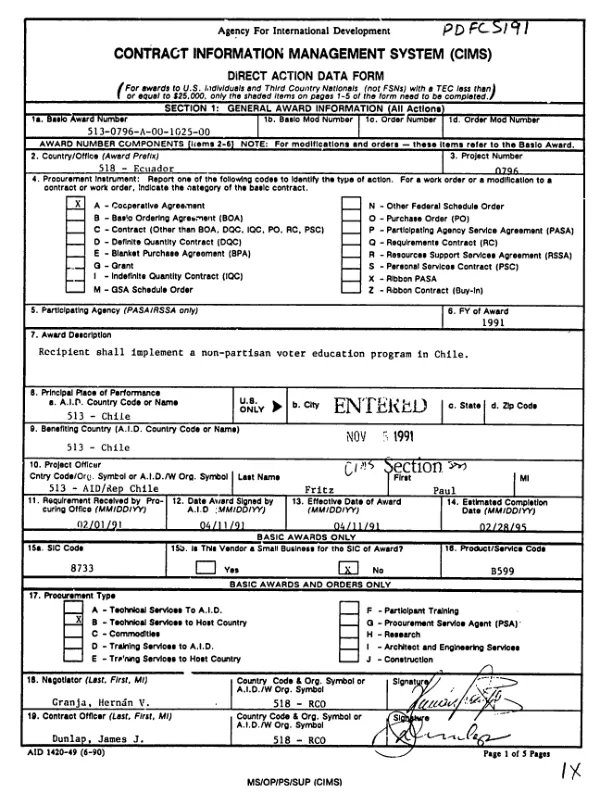
AID cooperative agreement no. 513-0796-A-00-1025-00 with Corporacion Participa for a non-partisan voter education program in Chile
Sign inUSAID. BUR. FOR LATIN AMERICA AND THE CARIBBEAN. REGIONAL OFC. FOR CENTRAL AMERICAN PROGRAMS (ROCAP)
AID cooperative agreement no. 513-0796-A-00-1025-00 with Corporacion Participa for a non-partisan voter education program in Chile
Grant to Corporacion Participa, a volunteer civic group in Chile, to support its nonpartisan voter education program.
1991
Sign in to readA free account is required to download.
Abstract
This grant, which follows on previous assistance provided through the Inter-American Institute of Human Rights (under project 5980591), has two major aims: to reintroduce formal secondary civic education; and to provide informal voter education for adult citizens and encourage voter registration. For the secondary education program, PARTICIPA will distribute a civic education textbook which it has prepared (with USAID financial support). Additionally, PARTICIPA will conduct seminars and training sessions to prepare classroom teachers to use the text. For informal civic education, PARTICIPA will use its volunteer network to expand its seminars (both regional and national), roundtable discussions, mass media information series, and educational materials distribution. Planned end of project status is as follows: 60,000 persons attend talks or roundtables on civic participation, democratization, and the local and national elections scheduled over the grant period; 1.2 million persons see informational leaflets on the above subjects; 9 regional programs are held for women and/or young people interested in training; 2 national debates are conducted for an audience of opinionmakers; and a media educational program has been implemented. In all activities, PARTICIPA will ensure its nonpartisan role. The organization will seek to keep an appropriate balance of political preferences both among its Board of Directors and volunteers; the latter shall be prohibited from engaging in partisan activities while representing PARTICIPA. Finally, PARTICIPA will implement the following institutional strengthening measures: upgrading middle management; creating regional chapters; and constantly identifying and testing additional means of resource generation.
Related documents
Documents in this collection
 1995
1995USAID DEC
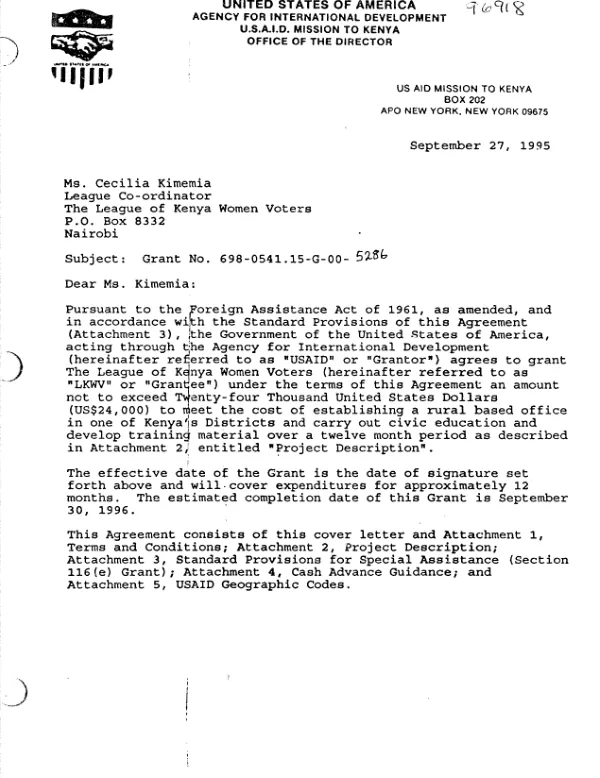
AID grant no. 698-0541.15-G-00-5286 to the League of Kenya Women Voters in support of establishing a rural based office in Kenya and carry out civic education and development training material
Open record 1998
1998USAID DEC