USAID DEC
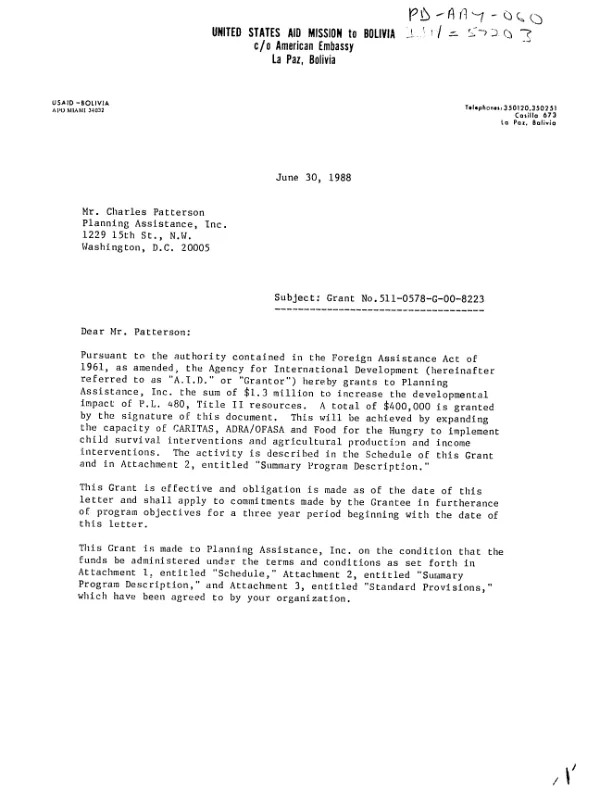
AID grant no. 511-0618-G-00-1144-00 with CARE/Bolivia for a community development project in Bolivia
Sign inUSAID. MISSION TO BOLIVIA
AID grant no. 511-0618-G-00-1144-00 with CARE/Bolivia for a community development project in Bolivia
Grant to CARE, follow on to 5110599, to improve infant and child nutrition and immunization among 48,000 people in 160 rural Bolivian villages in the departments of La Paz, Cochabamba, and one more as yet unnamed.
1991
Sign in to readA free account is required to download.
Abstract
The project will help develop community capabilities in the areas of primary health care (PHC), water and sanitation, agriculture, and community organization. CARE will implement the project in coordination with Bolivia"s regional Departmental Development Corporations. PHC efforts will be implemented through village health workers; these efforts will include health promotion, immunization, oral rehydration therapy, growth promotion, nutrition, hygiene, and, in 20 pilot villages, diagnosis and treatment of acute respiratory infections, prenatal care, and the supply of curative medicines. The component to provide potable water and excreta disposal services will rely heavily on village cash and in-kind contributions; it will also include a subsidy for villagers interested in building latrines. The agricultural component will complement other interventions, helping to decrease village emigration, ensure fuller use of the water supply, and increase the food supply. Besides activities in animal vaccination and de-parasitization, this component will include instruction and assistance in vegetable gardening (including a water-for-garden effort), composting, and silage production. Strengthened community organization will be the glue holding the other components together. A full-time CARE employee will be placed in every fifth village to work with community organizations in establishing subcommittees to supervise community-selected health, water, and agricultural workers. High impact interventions will aim to gain early village confidence. Sustainability of the project"s interventions will be addressed in a number of ways. Village workers will receive training in their respective project areas, and responsibility for project services will be gradually transferred to the workers and village organizations. A key will be the development of mechanisms to provide payment of fees-for-services to community workers; also planned is a community pharmacy pilot activity aimed at decreasing the flight of health workers and providing a supply of essential medicines in villages not served by the Ministry of Health. End of project targets are a 30% decrease in infant and child diarrheal morbidity; an 80% child immunization coverage; and a 30% decrease in child malnutrition.
Related documents
Documents in this collection
 1991
1991USAID DEC
AID grant no. ANE-0102-G-00-1041-00 to CARE to lower infant, child and maternal mortality and morbidity and to insure a better quality of life for persons with disabilities in Baken District, Pursat Province, Cambodia
Open record 1990
1990USAID DEC