USAID DEC
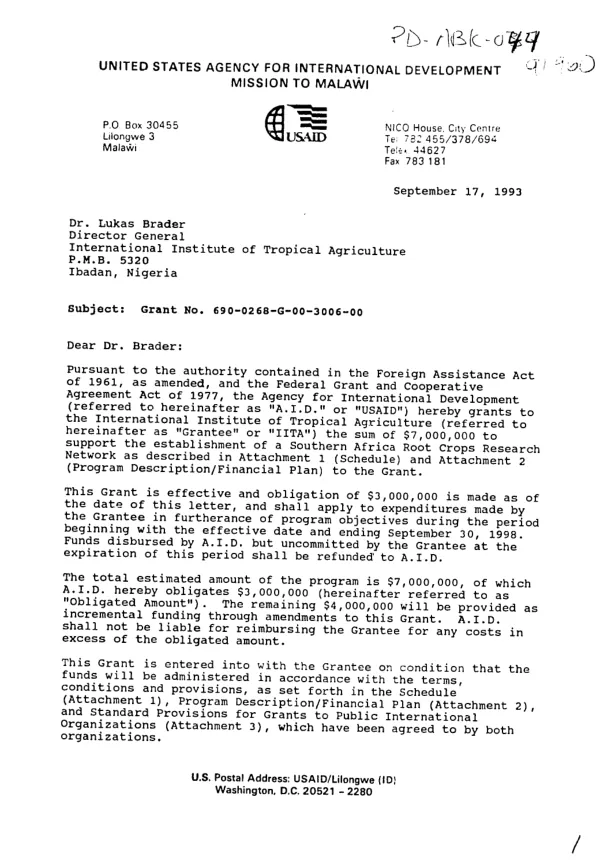
AID grant no. 690-0268-G-00-3006-00 to the International Institute of Tropical Agriculture to support the establishment of a Southern Africa root crops research network
Sign inUSAID. MISSION TO MALAWI
AID grant no. 690-0268-G-00-3006-00 to the International Institute of Tropical Agriculture to support the establishment of a Southern Africa root crops research network
Project to develop improved sweet potato and cassava varieties and practices and strengthen national root crop research capabilities in southern Africa by establishing the Southern Africa Root Crops Research Network (SARRNET).
1993
Sign in to readA free account is required to download.
Abstract
The International Institute of Tropical Agriculture (IITA), in collaboration with the International Potato Center (CIP) and participating National Agricultural Research Systems (NARS), will implement the project"s research, training, and information/technology transfer activities. SARRNET will provide a forum for the rapid exchange of technology and germplasm among NARS and other institutions, foster collaborative approaches to setting regional research and training priorities, and minimize duplication of research efforts. Regional research activities will focus on five objectives: ecologically sustainable plant protection with respect to cassava green mite and cassava mealybug (lead countries: Tanzania and Zambia); improved postharvest technologies for cassava (lead countries: Tanzania, Malawi, and Zambia); germplasm development and distribution (lead countries: Malawi and Zambia); on-farm trials, socioeconomic surveys, and monitoring systems to evaluate the adoption rate and impact of accepted varieties (all collaborating programs); and rapid multiplication and distribution of improved planting materials via establishment of primary multiplication centers at 3-4 sites in each national program (all collaborating programs). In addition to these regional activities, NARS country research activities are planned in Angola, Malawi, Mozambique, Namibia, Tanzania, Zambia, and Zimbabwe. Training will be provided through existing facilities and activities of participating countries and will include: (1) nondegree, in-service training for some 300 root crop researchers in integrated pest management, data collection and analysis, and field plot design; (2) M.S. training for 6 persons and Ph.D. training for 2; and (3) a program of visiting scholars to work with IITA, NARS, and other research organizations in specialized areas. Information and technology exchange will take place through a newsletter; the sponsorship of collaborators to symposia, meetings, and study visits; increasing NARS" access to relevant literature; and sponsoring regional workshops and exchange visits among scientists from cooperating NARS. Finally, the project will further support institutional capacity building by supporting TA for cooperating NARS.
Related documents