USAID DEC
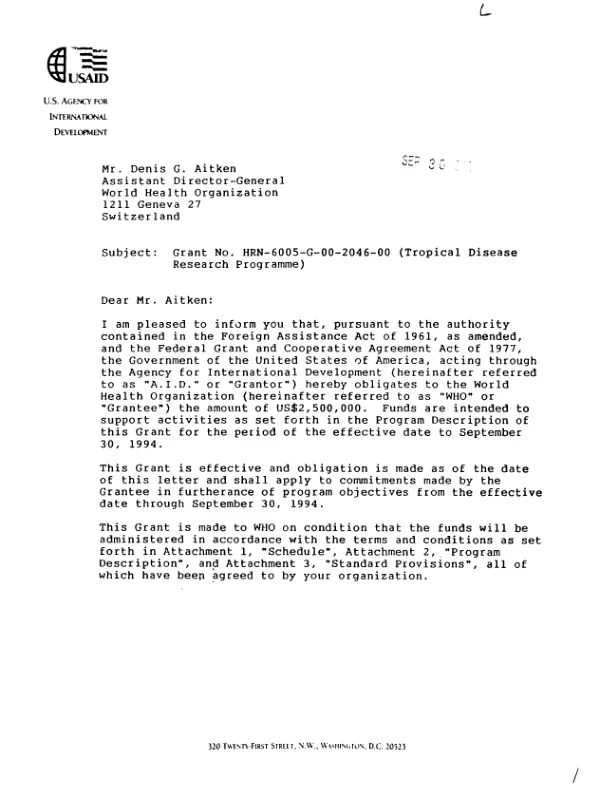
AID grant no. HRN-6005-G-00-2046-00 (tropical disease research programme) to the World Health Organization
Sign inUSAID. BUR. FOR RESEARCH AND DEVELOPMENT. OFC. OF HEALTH
AID grant no. HRN-6005-G-00-2046-00 (tropical disease research programme) to the World Health Organization
Project, follow-on to 9311126, to support the World Health Organization"s (WHO) Special Program in Tropical Disease Research and Training (TDR program).
1992
Sign in to readA free account is required to download.
Abstract
The program is a multidonor effort to (1) conduct scientific research on new methods of prevention, diagnosis, treatment, and control of major tropical diseases (malaria, schistosomiasis, filariasis, trypanosomiasis, leishmaniasis, and leprosy); and (2) strengthen the research capacity of disease-endemic countries. Among TDR"s target diseases, priority will be given to malaria, and particularly to developing new a new generation of antimalarial drugs (especially artemisinin derivatives). Work will also continue on development of malaria vaccines, improved diagnostic tests, and vector control methods such as impregnated bednets. For schistosomiasis, work will continue on developing a vaccine, new and improved approaches for controlling morbidity and disease transmission, simple, community-based diagnostic methods, and use of praziquantel, now available for less than $1 a treatment. For both lymphatic filariasis and onchocerciasis, research on new filaricides, especially macrofilaricides, will continue as a high priority. Research will also continue on sensitive and specific diagnostic tests for pre-patent, patent, and occult infection. DNA probes will be field-tested in control programs to monitor transmission. A major new initiative will be an integrated approach to drug development for African trypanosomiasis, Chagas disease, and leishmaniasis on the basis of similarities among their causal parasites. Additionally, work will continue on improving the use of existing drugs against sleeping sickness and on traps and screens to control tsetse flies. For leishmaniasis, work will continue on developing vaccines and diagnostic tests, tools for controlling reservoir hosts and vectors, and testing an ointment against cutaneous leishmaniasis. For leprosy, work will continue on improving the use of existing drugs and regimens and on developing new drugs and vaccines and new tools for laboratory and field use in epidemiological studies. In the field of biological vector control, work will continue on developing safe and effective control agents. A major new challenge will be to develop innovative strategies for controlling malaria through genetic manipulation of its vectors. Social and economic research will work toward the development of cost-effective, acceptable disease control measures and policies; efforts will also be made to integrate social and economic factors into the design and management of control strategies. TDR will also promote field research -- particularly field trials of new intervention tools -- and strengthen field research capacity in tropical disease-endemic countries. A major new initiative called Field Links for Intervention and Control Studies (FIELDLINGS) will establish multidisciplinary field research networks.
Related documents
Documents in this collection
 1993
1993USAID DEC
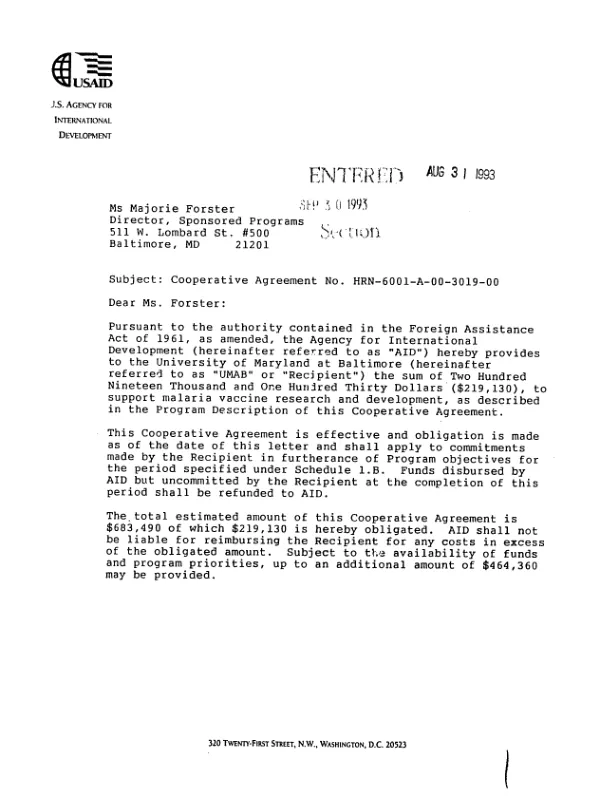
AID cooperative agreement no. HRN-6001-A-00-3019-00 with the University of Maryland at Baltimore (UMAB) to support malaria vaccine research and development
Open record 2003
2003USAID DEC