USAID DEC
AIDSTAR-One Success Story: Leveraging Resources for Sustainable Health Care Waste Management in Uganda
Sign inJOHN SNOW INTERNATIONAL
AIDSTAR-One Success Story: Leveraging Resources for Sustainable Health Care Waste Management in Uganda
AIDSTAR-One has played a crucial role in strengthening national planning and adoption of improved health care waste management (HCWM) in Uganda.
2012 · 2 pages
Sign in to readA free account is required to download.
Abstract
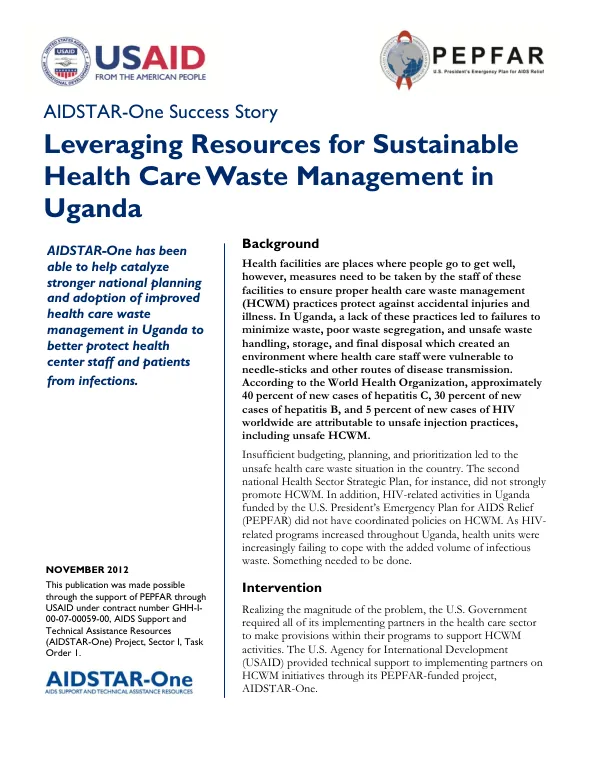
This effort aims to protect health center staff and patients from infections. The initiative began in 2012, with support from the U.S. President's Emergency Plan for AIDS Relief (PEPFAR) through the U.S. Agency for International Development (USAID) under contract number GHH-I-00-07-00059-00. Health facilities in Uganda were previously plagued by inadequate HCWM practices, leading to poor waste segregation, unsafe waste handling, storage, and final disposal. This created an environment where health care staff were vulnerable to needle-sticks and other routes of disease transmission. According to the World Health Organization, approximately 40 percent of new cases of hepatitis C, 30 percent of new cases of hepatitis B, and 5 percent of new cases of HIV worldwide are attributable to unsafe injection practices, including unsafe HCWM. AIDSTAR-One conducted baseline assessments at partner sites to develop a list of priority interventions. Each project receiving assistance developed HCWM plans, which were then carried out through targeted interventions. AIDSTAR-One ensured that templates used during planning were shared with the Ministry of Health's planning division, facilitating the finalization of a framework for district-specific HCWM annual plans. The organization also worked with the Department of Pharmacy at the Ministry of Health to incorporate priority HCWM commodities, such as safety boxes, into procurement plans. As a result of AIDSTAR-One's efforts, HCWM is now well-articulated in the third national Health Sector Strategic Plan and in guidelines for district and health facility annual planning. Guidelines for supervision have been revised to reflect new indicators of safe HCWM practices. Budgetary resources are now allocated to HCWM by different stakeholders, and regional referral hospitals have been awarded grants to cater to HCWM. At the health facility level, there have been improvements in the dissemination of guidelines, employment of waste handlers, availability of focal persons for HCWM, and use of safety boxes to safely dispose of sharps waste. The success of AIDSTAR-One's HCWM initiative in Uganda highlights the importance of coordinated efforts among stakeholders. Planning should take place through Ministry of Health structures to ensure rapid implementation at a national level. Sufficient budgetary allocation for HCWM is also critical, which can be achieved by incorporating HCWM into annual and sector plans, requiring implementing partners to allocate resources for HCWM activities, and providing technical assistance to improve individual project capacities to safely handle health care waste.