TEXAS A&M INTERNATIONAL UNIVERSITY
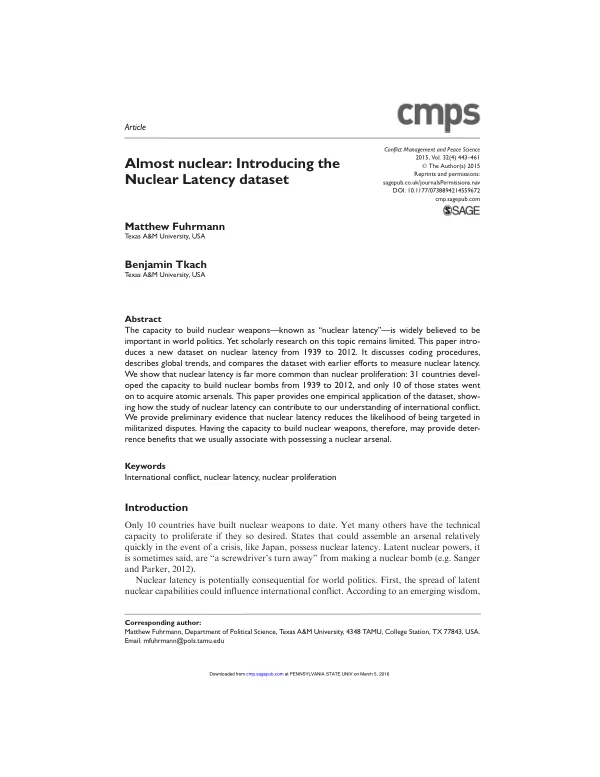
Almost nuclear: Introducing the Nuclear Latency dataset
Nuclear latency, the capacity to build nuclear weapons, is widely believed to be an important factor in world politics.
2015 · 19 pages
Sign in to readA free account is required to download.
Abstract
However, scholarly research on this topic remains limited. A new dataset on nuclear latency from 1939 to 2012 has been introduced, providing detailed information on the global spread of latent nuclear capabilities. The dataset focuses on the development of enrichment and reprocessing (ENR) facilities, which provide countries with the ability to produce fissile material, the most difficult step in making nuclear bombs. The dataset indicates that 31 countries developed latent nuclear capabilities over the last 70 years, with nuclear latency being three times more common than nuclear proliferation. In total, the dataset contains 241 ENR facilities built during the nuclear age, providing information on the operational history, size, and purpose of each plant. The dataset also reveals whether facilities were subjected to safeguards administered by the International Atomic Energy Agency (IAEA) and whether they were built covertly or with foreign assistance. The development of ENR facilities has been a global trend, with many countries investing in these capabilities. The dataset shows that the number of ENR facilities increased significantly in the 1950s and 1960s, with many countries building facilities to support their civilian nuclear programs. However, the dataset also reveals that some countries built ENR facilities covertly or with foreign assistance, highlighting the complex nature of nuclear latency. The study of nuclear latency can contribute to our understanding of international conflict dynamics. Preliminary evidence suggests that nuclear latency reduces the likelihood of being targeted in militarized disputes. Having the capacity to build nuclear weapons may provide deterrence benefits that are usually associated with possessing a nuclear arsenal. This finding has implications for the growing literature on the deterrent effects of nuclear weapons. Existing attempts to measure nuclear latency have been limited by the use of surrogate indicators and a lack of attention to ENR capabilities. The new dataset provides a more accurate picture of nuclear latency, highlighting the importance of ENR facilities in the development of latent nuclear capabilities. The dataset can be used to examine a host of questions related to the causes and effects of nuclear latency, including the impact of nuclear latency on international conflict dynamics. The dataset provides a comprehensive picture of the global spread of latent nuclear capabilities, highlighting the complex nature of nuclear latency. The study of nuclear latency can contribute to our understanding of international conflict dynamics, and the new dataset provides a valuable tool for researchers in this field. The dataset can be used to examine the impact of nuclear latency on international conflict dynamics, including the deterrent effects of nuclear weapons.
Related documents