USAID DEC
The Stabilization Lab: A Research and Education Initiative for American Engagement During Times of Conflict and Disaster
Sign inTEXAS A&M INTERNATIONAL UNIVERSITY
The Stabilization Lab: A Research and Education Initiative for American Engagement During Times of Conflict and Disaster
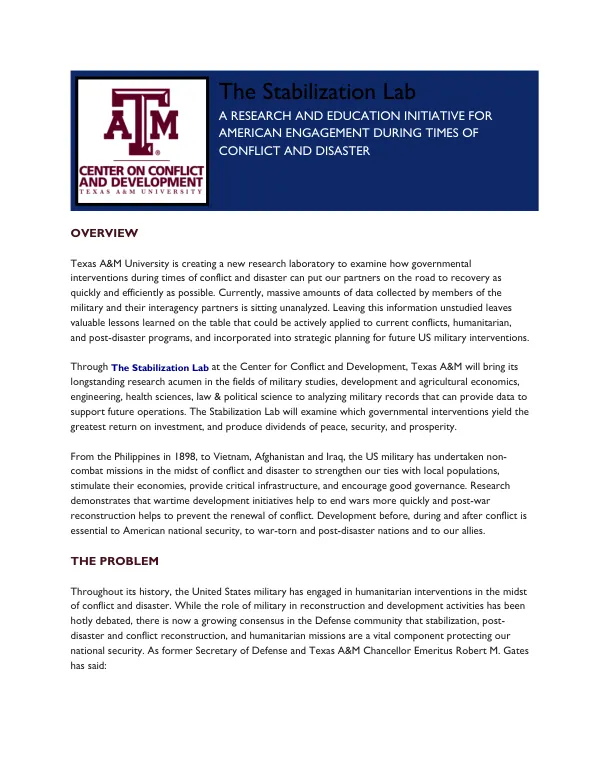
The Stabilization Lab is a research and education initiative created by Texas A&M University to examine governmental interventions during times of conflict and disaster.
6 pages
Sign in to readA free account is required to download.
Abstract
The lab aims to put partners on the road to recovery as quickly and efficiently as possible by analyzing massive amounts of data collected by the military and their interagency partners. This data, currently sitting unanalyzed, contains valuable lessons learned that could be actively applied to current conflicts, humanitarian, and post-disaster programs, and incorporated into strategic planning for future US military interventions. The lab will bring together Texas A&M's research acumen in military studies, development and agricultural economics, engineering, health sciences, law, and political science to analyze military records that can provide data to support future operations. The Stabilization Lab will examine which governmental interventions yield the greatest return on investment, and produce dividends of peace, security, and prosperity. The lab's research will focus on non-traditional missions, including humanitarian interventions, post-disaster reconstruction, and conflict stabilization. The lab will serve as a central repository and archive for all military, development, and local records, creating a searchable database of non-traditional missions. The database will include elements such as bilateral and multilateral investments, historical and current US military spending, district-level data, conflict and violence levels, food security, natural resource security, and value of investments. The lab will also conduct technical and policy analyses to determine the most effective interventions and techniques to help win hearts and minds, jump start broken economies, and rebuild communities. The Stabilization Lab will produce reports, studies, and workshops that can be readily utilized and incorporated into training for governmental practitioners. The lab will deliver findings to practitioners from several sectors, including defense, diplomacy, and development, to strengthen interagency cooperation before, during, and after conflict. The lab will also offer executive education and degree and non-degree training, and provide guidance on stability operations and reconstruction activities. The lab's integrated archive and online database will be a major resource for scholars and practitioners to learn from the record of CA and PRT contributions to community and economic development during war and humanitarian crises. The records will be declassified, digitized, and made accessible for research and training centers throughout the United States. The principles, policies, and practices derived from this record will be an important guide not only to the US military but also to our allied development practitioners. Texas A&M has assembled a strong roster of academics and practitioners involved in multiple facets of recent wars, including the Department of Agricultural Economics/Center for Conflict and Development, Bush School of Government and Public Service, School of Public Health, College of Engineering, School of Law, College of Liberal Arts, College of Business, the School of Military Science, and the Texas A&M AgriLife Research and Extension agencies. The lab requires a budget of $12,500,000 over the next five years to support its work and attract the day-to-day talent needed to continue it.