JOHNS HOPKINS UNIVERSITY
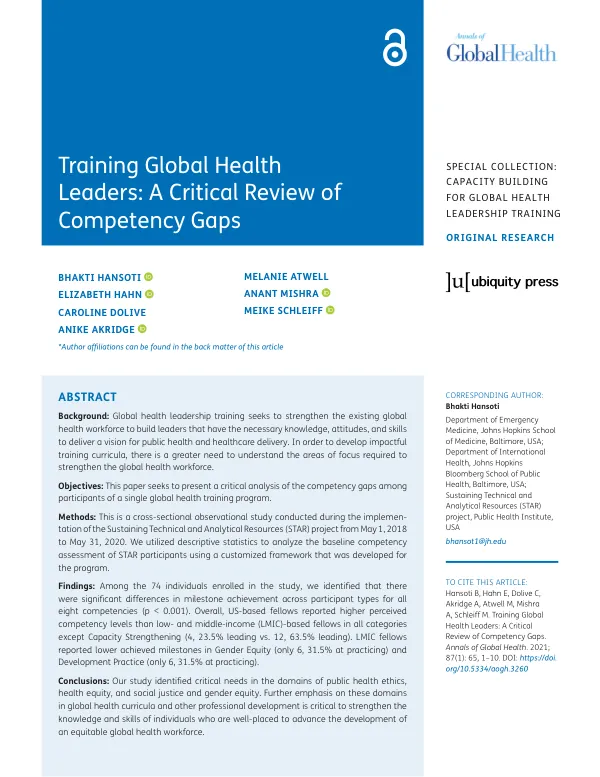
Training Global Health Leaders: A Critical Review of Competency Gaps
Global health leadership training is a critical component in strengthening the existing global health workforce.
2021 · 10 pages
Sign in to readA free account is required to download.
Abstract
The shortage of human resources in the form of public health leaders and health professionals has become a prominent obstacle to sustaining health programs and improving health outcomes. Effective global health leaders can play a pivotal role in various health initiatives, provided they have the appropriate technical and leadership training to make a lasting impact. The Sustaining Technical and Analytical Resources (STAR) project is a fellowship and internship program administered by the Public Health Institute and supported by the United States Agency for International Development (USAID). STAR participants are based in both the US and low- and middle-income countries (LMICs), represent a range of experience levels, and work across a wide range of focus areas. To inform the learning activities of STAR participants, the program built on existing competency frameworks to develop a strategy to capture the growth and training needs of participants across the program. The STAR competency framework includes eight core competency domains and 20 technical domains. The eight core competencies reflect four "Power Skills" (Communication and Interpersonal Effectiveness, Development Practice, Cross-Cultural Practice, and Capacity Strengthening) and four "Essential Perspectives" (Public Health Ethics, Global Burden of Disease, Gender Equity, and Health Equity and Social Justice). Measurable milestones at five levels ("Inquiring," "Understanding," "Practicing," "Leading," and "Advancing") are defined for each competency domain, with specific roles and responsibilities for different kinds of participants. A cross-sectional observational study was conducted during the implementation of the STAR project from May 1, 2018 to May 31, 2020. All STAR participants and interns who completed their onboarding process during the study period were included in the sample. The primary outcome of this study was to determine the baseline competency for each participant across the eight core competency domains to understand the baseline strengths and gaps of participants entering the STAR project. The study found significant differences in milestone achievement across participant types for all eight competencies. US-based fellows reported higher perceived competency levels than LMIC-based fellows in all categories except Capacity Strengthening. LMIC fellows reported lower achieved milestones in Gender Equity and Development Practice. The study identified critical needs in the domains of public health ethics, health equity, and social justice and gender equity. Further emphasis on these domains in global health curricula and other professional development is critical to strengthen the knowledge and skills of individuals who are well-placed to advance the development of an equitable global health workforce. The STAR project's competency assessment framework provides a comprehensive approach to understanding the training needs of global health professionals. The framework's focus on measurable milestones and specific roles and responsibilities for different kinds of participants allows for tailored learning opportunities and individualized professional development plans. The study's findings highlight the importance of addressing competency gaps in global health leadership training to build a strong and effective global health workforce.
Related documents