USAID DEC
Alternative Care in Guatemala: An Analysis of Kinship Care and Foster Care
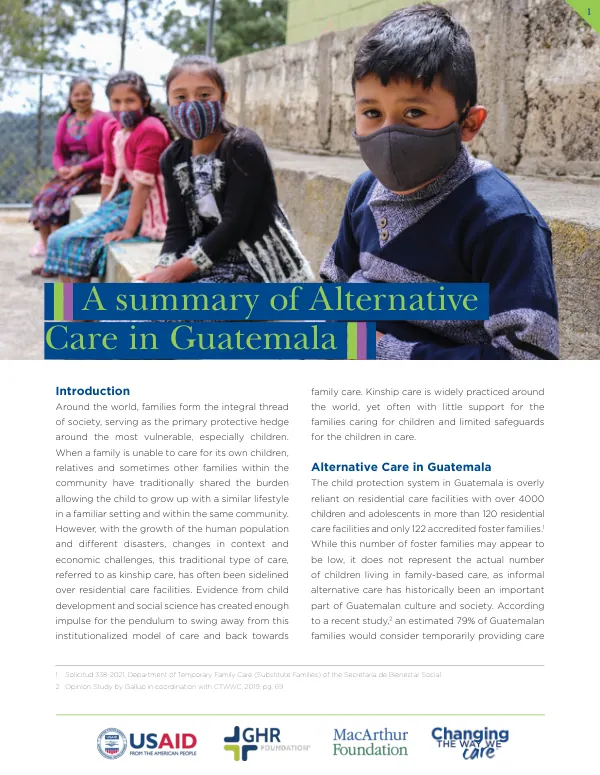
The child protection system in Guatemala is heavily reliant on residential care facilities, with over 4,000 children and adolescents residing in more than 120 institutions.
2021 · 4 pages
Sign in to readA free account is required to download.
Abstract
However, this model of care has been criticized for its institutionalized nature, and there is a growing trend towards family-based care. Kinship care, in particular, is widely practiced in Guatemala, with an estimated 79% of families willing to provide temporary care for a child in need. The Secretaría de Bienestar Social (SBS) is the government entity responsible for recruiting, training, and certifying foster families. However, the process is often slow, and the number of certified foster families is limited, with only 122 accredited families in the country. Foster families receive a stipend of Q 1,200 ($158) per month from the SBS, which is essential to their wellbeing. The Supreme Court has issued guidelines on foster care, stating that placements should not exceed six-month periods, but judges have the jurisdiction to extend this period based on the best interest of the child. Kinship care is a more informal and less-documented option, with 41% of families reporting that they have cared for a child who was not their own. However, this type of care is often done with little to no governmental oversight. The concept of kinship care has been formalized by the Supreme Court, providing judges with a legal framework for placing children and youth with families or individuals who have "affective ties" to them. This has provided an alternative measure for judges to place children and youth with families or individuals who are not related to them. The SBS has begun to delegate certain steps of the foster care process to NGOs, sharing the load of recruiting, training, and providing follow-up while retaining the exclusive right to certification. This has resulted in more teenagers, children with special needs, and sibling groups being placed in foster care families. However, the prohibition on foster families applying to be adoptive families of the children they care for prevents some children from finding a permanent solution and the restitution of their rights to a formalized identity in their families. In some cases, judges seek to change the status from foster care to extended family, but this change in status would prevent the foster families from receiving the stipend that is essential to their wellbeing. The concept of kinship care has existed in informal ways as a component of the culture, with many families caring for children who are not their own. However, this is typically done with little to no governmental oversight, and there is a need for better and more defined archetypes of alternative care. The child protection system in Guatemala is facing significant challenges, including a lack of formalized kinship care and a reliance on residential care facilities. However, there are efforts underway to address these challenges, including the SBS's delegation of certain steps of the foster care process to NGOs and the formalization of kinship care by the Supreme Court. These efforts aim to provide children and youth with more suitable and permanent solutions, and to support families in their role as caregivers.