 1988
1988USAID DEC
USAID. MISSION TO INDIA
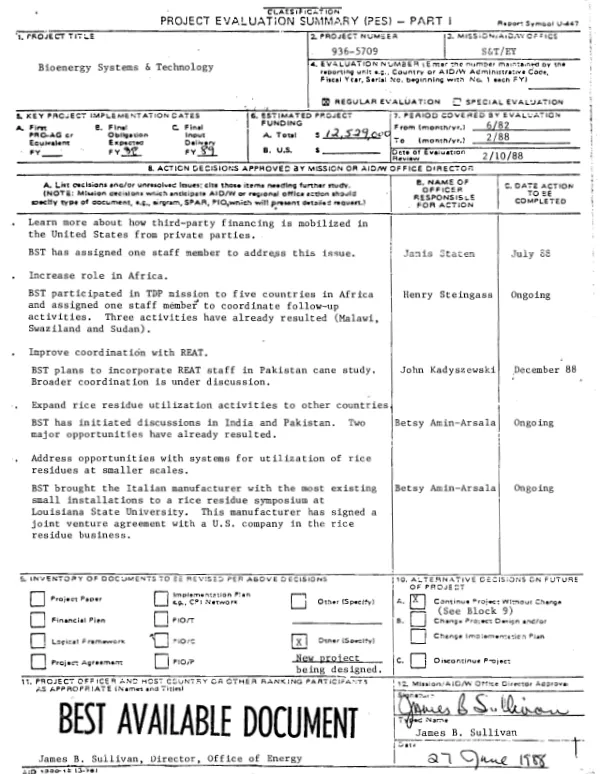
Evaluates project to expand the Government of India"s (GOI) technical ability to exploit and develop alternative energy resources.
Swain, Diana; Thormand, Peter · 1984
Abstract
PES covers the period 6/82-9/84 and is based on document review and interviews with project officers. The long lead time required to receive GOI subproject (SP) approval, slow AID/W response to USAID/I requests, and the creation of a new implementing agency (the Department of Non-Conventional Energy Sources - DNES) have slowed implementation and necessitated a 1-year project extension. However, substantial progress is being made in in two of the four project components. (1) Under the Biomass and Coal Conversion component, three biomass conversion and five coal conversion SP"s have been active since early 1984; in addition, a successful coal and biomass conversion workshop was sponsored in 11/83 and a second is planned for 11/84. (2) Approval of SP proposals for the Biomass Production component has been delayed by the GOI since 9/82; revised proposals have been approved by DNES and are awaiting final GOI acceptance. (3) GOI approval of the Energy Efficiency in Industry and Transportation component took approximately 1.5 years, and progress was further delayed by slow AID/W action in processing a grant to the National Academy of Science. The grant was signed in 9/84 and the Association of Indian Engineering Industries is now beginning to plan energy efficiency workshops. (4) Under the Information Exchange in New and Renewable Energy component, two collaborative subprojects are fully underway - between Brookhaven National Laboratory (BNL) and the Solar Thermal Energy Center to field test a polymer film collector, and between Boston and Roorkee Universities to develop a mini and low head hybrid hydroelectric system. Collaboration between BNL and the Tata Energy Research Institute to develop a national planning model for nonconventional energy is planned. Overall, 12 of 20 planned SP"s are being implemented. Lessons learned are that coordination with AID/W should be tighter to avoid unnecessary delays and that given GOI delays in approving SP"s unrealistic goals should not be set during the project"s first few years. Three action decisions are made.
Connected topics
Classification