USAID DEC
Aluminum hydroxide supported on zeolites for fluoride removal from drinking water
Aluminum hydroxide supported on zeolites have been studied for their potential to remove fluoride from drinking water.
2016 · 1 pages
Sign in to readA free account is required to download.
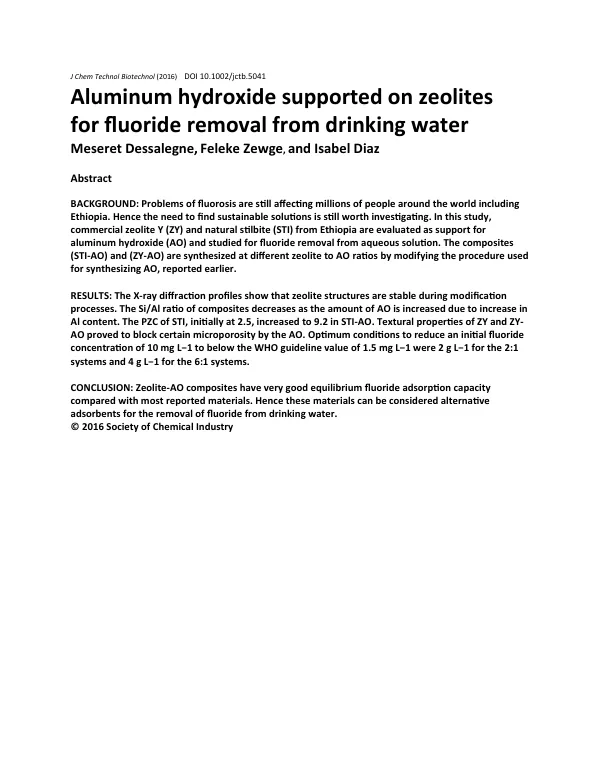
Abstract
Commercial zeolite Y (ZY) and natural silbite (STI) from Ethiopia were evaluated as supports for aluminum hydroxide (AO). The composites STI-AO and ZY-AO were synthesized at different zeolite to AO ratios by modifying the synthesis process for AO. The X-ray diffraction profiles of the zeolite structures showed that they maintained their integrity during the modification process. The Si/Al ratio of the composites decreased as the amount of AO increased, resulting in an increase in Al content. The point of zero charge (PZC) of STI, initially at 2.5, increased to 9.2 in STI-AO. The textural properties of ZY and ZY-AO showed that the AO blocked certain microporosity in the zeolite. Optimal conditions for removing an initial fluoride concentration of 10 mg L−1 to below the World Health Organization's guideline value of 1.5 mg L−1 were 2 g L−1 for the 2:1 systems and 4 g L−1 for the 6:1 systems. The zeolite-AO composites demonstrated a very good equilibrium fluoride adsorption capacity compared to most reported materials. These materials have the potential to serve as alternative adsorbents for removing fluoride from drinking water. The results suggest that zeolite-AO composites can be used to address the problem of fluorosis, which affects millions of people worldwide, including Ethiopia. The use of natural silbite from Ethiopia as a support for AO is also noteworthy, as it provides a locally sourced and potentially more cost-effective option for fluoride removal.
Related documents
Documents in this collection
 2019
2019USAID DEC
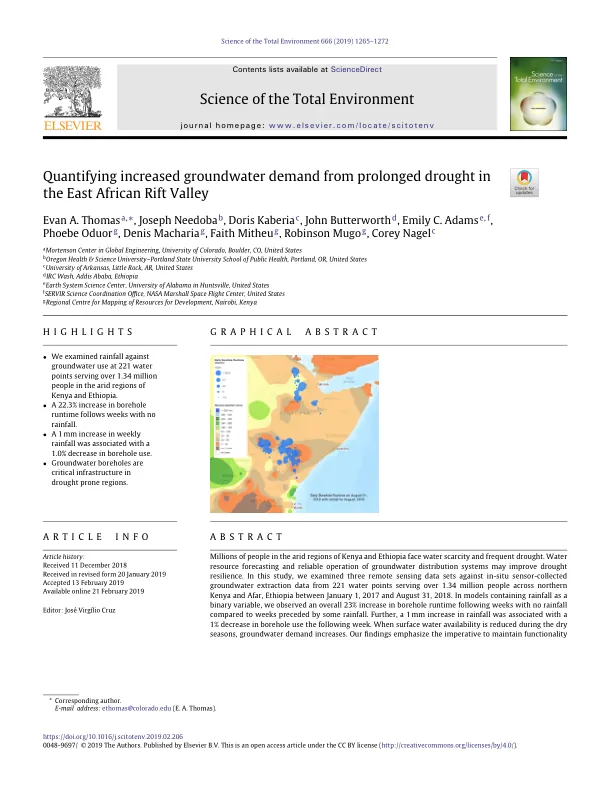
Quantifying increased groundwater demand from prolonged drought in the East African Rift Valley
Open record 2019
2019USAID DEC