USAID DEC
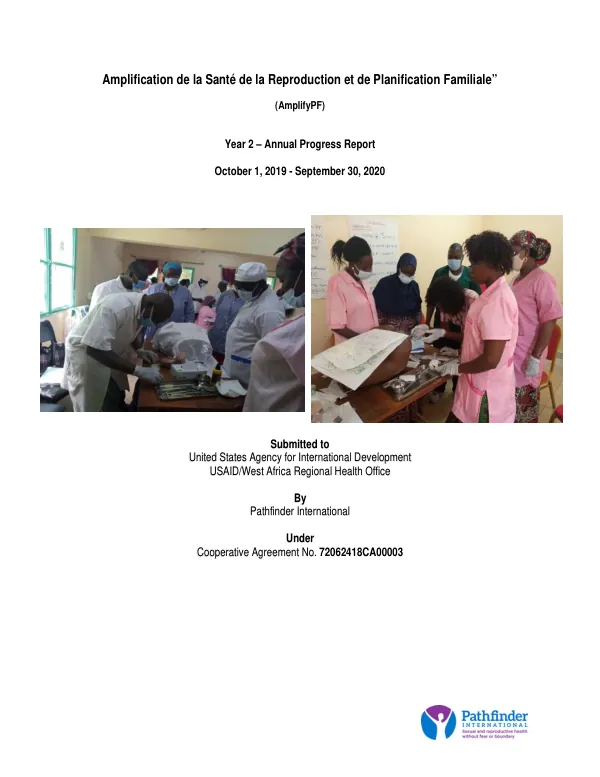
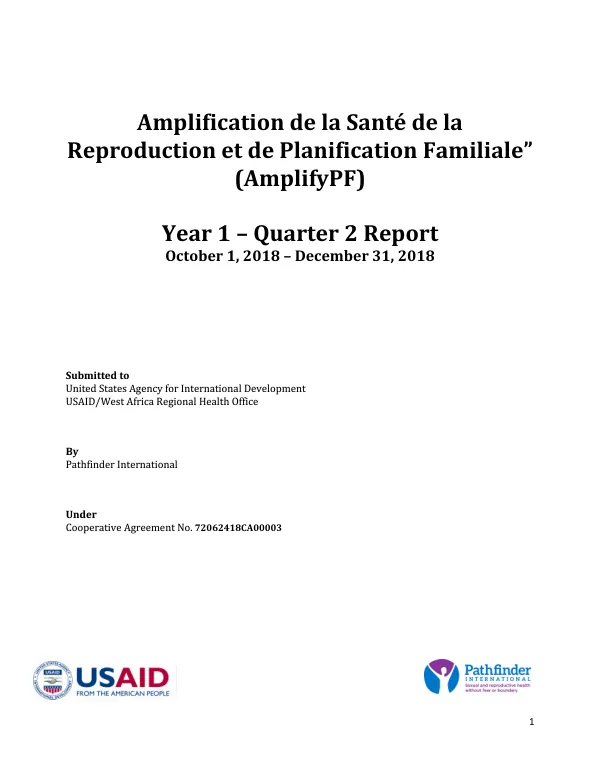
Amplification de la Santé de la Reproduction et de Planification Familiale (AmplifyPF) Year 1 – Quarter 2 Report
Sign inPATHFINDER INTERNATIONAL
Amplification de la Santé de la Reproduction et de Planification Familiale (AmplifyPF) Year 1 – Quarter 2 Report
The Amplify Family Planning and Sexual Reproductive Health project, also known as Amplify PF, is a USAID-funded initiative aimed at expanding access to and utilization of quality family planning services in the West Africa region.
2018 · 31 pages
Sign in to readA free account is required to download.
Abstract
The project focuses on Burkina Faso, Niger, Côte d'Ivoire, and Togo, with the goal of mobilizing partners to build sustainability and scale of selected high-impact practices. During the second quarter of the project, which spanned from October 1, 2018, to December 31, 2018, the project completed crucial start-up steps. These included onboarding country team members in Burkina and Niger, pursuing registration of Pathfinder International in Togo, acquiring insurance for project vehicles, and preparing and submitting the project's first annual work plan to USAID. The project also faced challenges to implementation, including delays in Pathfinder Office registration in Togo, recruitment delays in Togo and Côte d'Ivoire, and limited IT equipment within country offices and the regional office. The project's objective is to strengthen and institutionalize a system for adaptation and replication of key family planning high-impact practices. To achieve this, the project implemented activities relevant to intermediate result 1.1, which involves establishing integrated learning networks (ILNs) in four target countries. The project developed standards for selecting districts, which included criteria such as prior support from the AGIR-PF project, large and underserved population catchment areas, and strong links to community-based demand creation activities. The project selected a total of 16 districts across the four countries, with Burkina Faso, Côte d'Ivoire, Niger, and Togo each contributing four, five, five, and two districts, respectively. The districts were selected based on criteria such as prior support from ongoing platform projects, hospital presence, and community-based demand creation activities. The project also supported the finalization of year one work plans for each beneficiary country, as well as the validation of districts selection criteria and the selection of districts eligible for ILN model introduction. This activity was considered the most important of the quarter and followed the submission of the year one work plan. The project's focus on establishing ILNs in selected districts is aimed at promoting the adaptation and replication of key family planning high-impact practices. The project's activities and achievements during the second quarter demonstrate its commitment to achieving its objectives and building sustainability and scale of selected high-impact practices in the West Africa region. The project's implementation challenges, including delays in registration and recruitment, highlight the need for continued support and resources to ensure the project's success. The project's focus on building partnerships and collaborating with other USAID FP/RH partners is also crucial to achieving its objectives and promoting the adoption of high-impact practices in the region. The project's progress and achievements during the second quarter demonstrate its potential to make a significant impact in the West Africa region. The project's focus on building sustainability and scale of selected high-impact practices is critical to achieving its objectives and promoting the adoption of family planning services in the region.
Related documents