USAID DEC
Amplification de la Santé de la Reproduction et de Planification Familiale: Year 2 – Annual Progress Report
Sign inPATHFINDER INTERNATIONAL
Amplification de la Santé de la Reproduction et de Planification Familiale: Year 2 – Annual Progress Report
The Amplify Family Planning and Sexual Reproductive Health project, also known as AmplifyPF, is a USAID-funded initiative aimed at expanding access to and utilization of quality family planning services in the West Africa region.
2020 · 24 pages
Sign in to readA free account is required to download.
Abstract
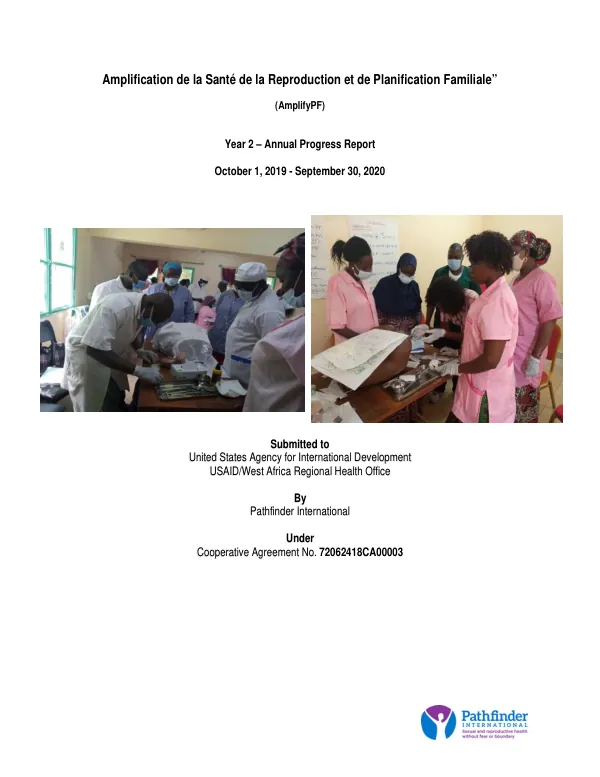
The project focuses on four countries: Burkina Faso, Côte d'Ivoire, Niger, and Togo. AmplifyPF has four interrelated objectives: strengthening and institutionalizing a system for adaptation and replication of key family planning high impact practices, engaging and leveraging domestic, donor, and West African communities and resources to build sustainability and scale of selected High Impact Practices, institutionalizing a sustainable and self-regulating system of service quality assurance and monitoring, and collaborating and coordinating with other USAID Family Planning and Reproductive Health partners. During its second year of implementation, AmplifyPF successfully established 12 Integrated Learning Networks (ILNs) in health districts across the four countries. The ILN model focuses on leveraging the network of health resources within a district to foster replication of High Impact Practices, leading to an increased uptake of family planning. Within the ILN, AmplifyPF worked with district stakeholders to identify district resources and readiness to implement Post-Partum Family Planning, Post Abortion Family Planning, and FP task shifting. AmplifyPF led three Family Planning Special Days (Journée Spéciale de la PF, or JSPF) and Systematic Identification of Client Needs (Identification Systématique des Besoins de la Cliente, or ISBC) to kick-off increased FP services in the ILNs. The project also developed a system for quality assurance evaluation of the ILN system, with a focus on high quality High Impact Practice service provision. Additionally, AmplifyPF served an important national and regional FP advocacy and coordination role, contributing to national FP policy discussion and development in all four supported countries and ensuring FP regional partners share information and coordinate towards shared goals. Due to the COVID-19 pandemic, AmplifyPF undertook an assessment of the impact of the pandemic on FP services in the project's four target countries using quantitative data from health districts and collecting qualitative data through interviews with key health officials at national, regional, and district levels. The assessment aimed to understand the potential negative impact of the pandemic on the continuity of FP services. Key achievements during Year 2 include: * 395,239 FP clients visited the health facilities of the 17 ILNs, among which 93,213 are new users; * 298,493 Couple-Years of Protection (CYP) achieved by the health facilities of the 17 ILNs; * 179,881 women received awareness raising on FP through Amplify supported ISBC and JSPF; * 27,291 clients accepted a modern contraceptive method of their choice through ISBC and JSPF, among whom 10,744 were new users through ISBC approach and 6,026 through JSPF; * Baseline needs assessments completed in the 17 ILNs in the 4 AmplifyPF target countries; * 897 providers received orientation on the ISBC related to FP; * 643 participants at Community Dialogue and Site Walkthrough visits in ILNs; * 517 providers received training on the FPPP/FPPA counseling and DMPA-SC. These achievements demonstrate the project's progress in expanding access to and utilization of quality family planning services in the West Africa region, despite the challenges posed by the COVID-19 pandemic.