CREATIVE ASSOCIATES INTERNATIONAL INC.
An assessment and approach to address food security and hunger
Yemen has a long history of agricultural production, with the sector remaining important for its contribution to gross domestic product (GDP) and its role in food security and employment in rural areas.
2012 · 66 pages
Sign in to readA free account is required to download.
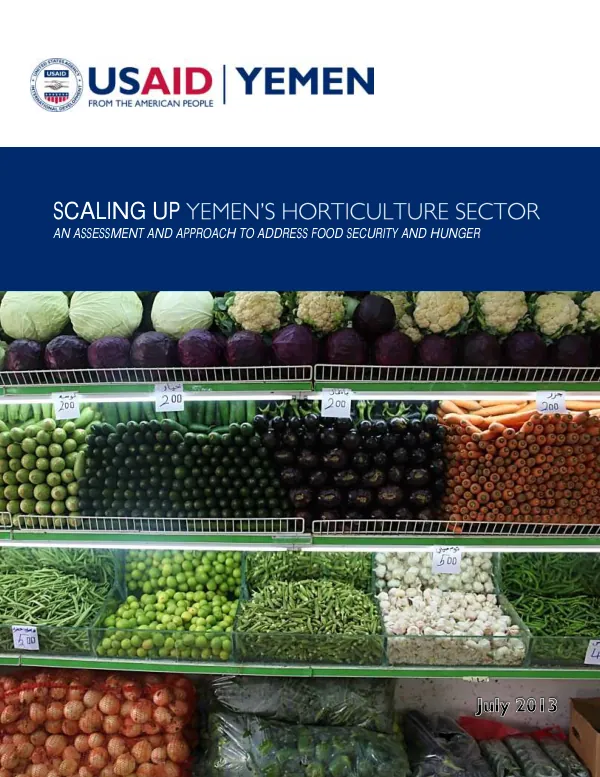
Abstract
In recent years, Yemen has diversified agriculture by investing in irrigation systems and higher value annual horticulture crops. However, a 2012 World Food Programme report found that over 50 percent of the population was food insecure, with 22 percent being severely food insecure. Additionally, two million children under five were chronically malnourished, and one million were acutely malnourished. The volumes of horticultural products are increasing due to increased irrigated land area rather than increased productivity. The recommendations point to the value of building capacity throughout the value chain to increase profits, strengthen food security, and address hunger. This report aims to provide an objective assessment of the horticulture sector in Yemen to identify potential opportunities for strengthening its food security. The report is organized into three main sections that reflect the tasks assigned to the research team, aligned with development objectives of the United States Agency for International Development (USAID) and priorities of the Feed the Future Initiative. Section 1 includes an overview of the horticulture sector, highlighting cross-cutting issues such as gender, climate change, and water, qat, and small enterprise development. Section 2 provides an in-depth analysis of the horticulture value chain, a SWOT analysis, and market opportunities. Section 3 describes an integrated approach to strengthen the value chain in Yemen. The report is a result of extensive research, consultations with key stakeholders, and direct observations in the field by staff of the USAID Community Livelihoods Project (CLP). Stakeholder consultations were conducted with farmers in Yemen, the Yemen Ministry of Agriculture and Irrigation (MAI), sector specialists, and value chain actors. The research team evaluated the market system, market opportunities, and market segmentation, including interviews with importers, market intermediaries, and supermarkets. Key findings indicate that weaknesses in the value chain are impacting the quality of horticulture products. The sector lacks innovative approaches, quality cost-effective inputs, crop protection strategies, and credit availability. Research and development, public sector institutional capacity, extension services, and technical assistance are weak. The capacity of farmers needs strengthening, as they lack entrepreneurship and experience significant post-harvest losses. The report aims to provide an objective assessment of the horticulture sector in Yemen to identify potential opportunities for strengthening its food security. The findings and recommendations in this report are intended to be of interest to stakeholders in horticulture, the Republic of Yemen Government (RoYG), and donor agencies exploring potential opportunities to support future development that addresses food security and creates a more stable and resilient economy for the people of Yemen. The horticulture sector in Yemen is characterized by a lack of innovative approaches, quality cost-effective inputs, crop protection strategies, and credit availability. The sector is also marked by weak research and development, public sector institutional capacity, extension services, and technical assistance. The capacity of farmers needs strengthening, as they lack entrepreneurship and experience significant post-harvest losses. The report highlights the importance of building capacity throughout the value chain to increase profits, strengthen food security, and address hunger. The recommendations point to the value of investing in irrigation systems and higher value annual horticulture crops. The report aims to provide an objective assessment of the horticulture sector in Yemen to identify potential opportunities for strengthening its food security. The horticulture sector in Yemen is a significant contributor to the country's gross domestic product (GDP) and plays a crucial role in food security and employment in rural areas. However, the sector faces several challenges, including a lack of innovative approaches, quality cost-effective inputs, crop protection strategies, and credit availability. The sector is also marked by weak research and development, public sector institutional capacity, extension services, and technical assistance. The report highlights the importance of strengthening the capacity of farmers, as they lack entrepreneurship and experience significant post-harvest losses. The report also emphasizes the need to invest in irrigation systems and higher value annual horticulture crops to increase productivity and increase the volumes of horticultural products. The report aims to provide an objective assessment of the horticulture sector in Yemen to identify potential opportunities for strengthening its food security. The horticulture sector in Yemen is a
Related documents