USAID DEC
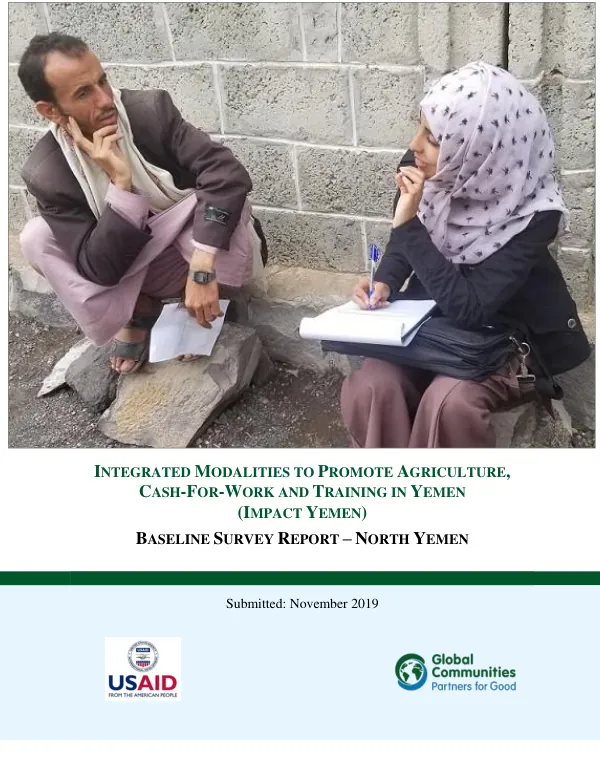
Integrated Modalities to Promote Agriculture, Cash-for-Work and Training in Yemen (IMPACT Yemen) Baseline Survey Report – North Yemen
Sign inGLOBAL COMMUNITIES
Integrated Modalities to Promote Agriculture, Cash-for-Work and Training in Yemen (IMPACT Yemen) Baseline Survey Report – North Yemen
The agricultural sector in Yemen is severely impacted by ongoing conflict, resulting in widespread poverty and food insecurity.
2019 · 26 pages
Sign in to readA free account is required to download.
Abstract
The World Bank estimates that as of 2018, 81% of the population were under the poverty line, with millions unable to meet basic needs without assistance. The day labor that many poorer Yemenis rely on for their meager incomes has decreased, forcing many to draw down savings or sell their few valuable assets. Economic recession, depreciation of the national currency, soaring food and fuel prices, disrupted markets, and loss of employment opportunities have contributed to extreme vulnerability to food insecurity throughout the country. To address the urgent multi-sector humanitarian needs of 74,908 vulnerable, conflict-affected Yemenis in Sana'a, Ibb, Taiz, Dhamar, Aden, Lahj, and Dhale Governorates, the USAID-funded program Integrated Modalities to Promote Agricultural, Cash-for-Work, and Training in Yemen (IMPACT Yemen) was established. The program aims to improve water, sanitation, and hygiene (WASH), food security and agricultural productivity, and economic recovery and livelihoods. For this assessment, Global Communities conducted questionnaire interviews with 629 individual households in IMPACT Yemen's northern areas of operation in Sana'a, Ibb, Taiz, and Dhamar Governorates. The average household family size is eight or more in all survey districts, with a high dependency ratio affecting household food security status. Married males have a higher percentage, while female widows are higher with 59%. Widow-headed households bear a greater burden in taking care of the families in addition to their key responsibility for securing household income and food security. The level of education is low in general, with 29% of respondents having not had any form of formal education and only 21% able to read and write. The percentage of individuals surveyed with special needs is high in two districts, with 34% in Modhaykhirah and 27% in Fara Al Udayn. Pregnant and lactating women accounted for 21% of the total sample population at the time of the baseline survey. Overall, 9% of households with children under five reported that at least one child suffers from malnutrition. The Baseline Survey revealed that most of the communities access water from wells with functional pumps, with responsibility for water collection balanced among women and men. However, 70% of respondents said that the amount of water they received was not sufficient to meet their daily requirements. More than 52% of the baseline survey participants washed/cleaned their water containers using water and soap, while 78% of households do not treat their drinking water. Despite this, most of the survey respondents (75%) perceived the water quality as very good. Income in the respondent households is earned mainly through agriculture (59%) and pastoralism (49%). Many respondents (46%) reported a monthly income of less than 20,000 YR. Household food sources are limited, with 44% of households relying on food assistance programs. The majority of households (71%) reported that they do not have access to a market, with 55% of respondents indicating that they do not have a stable source of income. The Baseline Survey highlights the urgent need for humanitarian assistance to address the multi-sector humanitarian needs of vulnerable, conflict-affected Yemenis.