USAID DEC
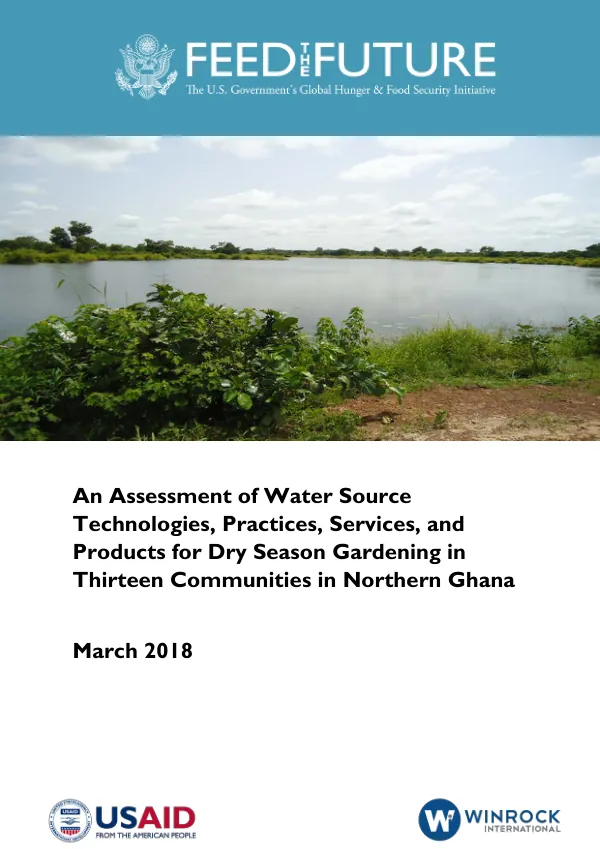
An Assessment of Water Source Technologies, Practices, Services, and Products for Dry Season Gardening in Thirteen Communities in Northern Ghana
Sign inUSAID
An Assessment of Water Source Technologies, Practices, Services, and Products for Dry Season Gardening in Thirteen Communities in Northern Ghana
The Ghana Agriculture and Natural Resource Management Project conducted an assessment of water source technologies, practices, services, and products for dry season gardening in thirteen communities in Northern Ghana.
2018 · 34 pages
Sign in to readA free account is required to download.
Abstract
The assessment aimed to identify suitable irrigation techniques and practices for household and community level dry season gardening. Irrigation technologies and systems were evaluated, including buckets, basins, and watering cans, treadle pumps, motorized pumps, solar pumps, shallow and open wells, borehole drilling, shallow tube wells, canal and pipe conveyance systems, open gravity canal systems, low-pressure pipe systems, sprinkler irrigation systems, drip irrigation systems, and small-scale and community irrigation systems. The assessment found that these technologies have varying levels of suitability for dry season gardening in the focal communities. The assessment focused on the CREMA communities, including Wiasi, Katiu, Dabozesi, Bienye, Jambusi, Kukpali, Dogberipari, Donye, Wechiau, Takpo, Siiru, and Nanville. The findings from these communities highlighted the importance of suitable irrigation techniques and practices for dry season gardening. For example, in Wiasi, the assessment recommended the use of treadle pumps and shallow tube wells for dry season gardening. In Katiu, the assessment recommended the use of solar pumps and drip irrigation systems. Rain water harvesting techniques and practices were also evaluated, including estimation of storage and catchment area, storage facilities, and estimated cost of storage systems. The assessment found that rain water harvesting can be a viable option for dry season gardening in the focal communities, particularly in areas with high rainfall. The assessment concluded that suitable irrigation techniques and practices for dry season gardening in the focal communities include the use of treadle pumps, shallow tube wells, solar pumps, drip irrigation systems, and rain water harvesting. The assessment also recommended the use of storage facilities and estimated the cost of storage systems. The findings from the assessment can inform the development of dry season gardening programs in the focal communities and provide guidance for farmers and extension agents on suitable irrigation techniques and practices.