THE ASIA FOUNDATION
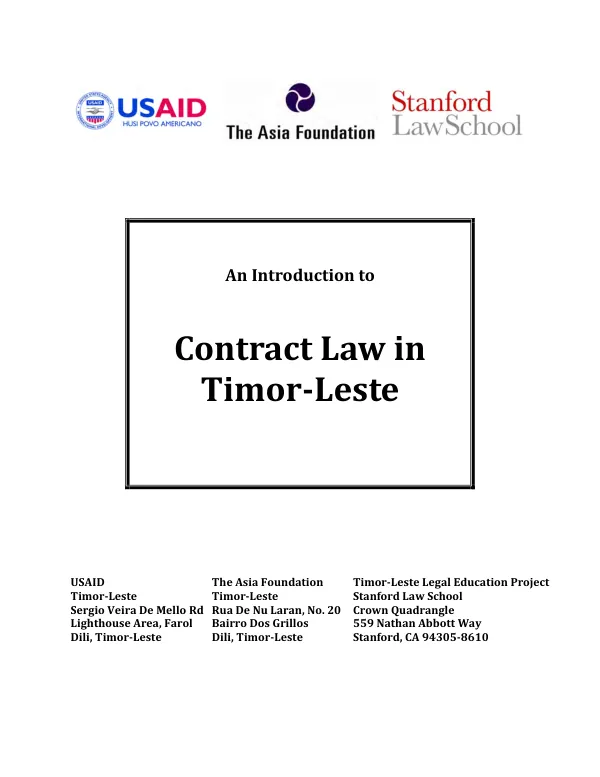
An Introduction to Contract Law in Timor-Leste
Contract Law in Timor-Leste is a comprehensive guide to understanding the principles and regulations governing contracts in the country.
2012 · 195 pages
Sign in to readA free account is required to download.
Abstract
The document begins by defining contracts and explaining the reasons for contract law, including the need for enforceability and the protection of parties' rights. The formation of contracts is a critical aspect of contract law, and the document delves into the concept of legal capacity, which refers to a person's ability to enter into a contract. The document explains that individuals lacking legal capacity, such as minors or those with mental incapacities, may not be able to enter into contracts, and that parents or guardians may be able to make contracts on their behalf. The document also discusses the objects of legal transactions, including declarations of willingness, form, perfection, interpretation, and incorporation. The document also explores the concept of nullity and annulability of legal transactions, which refers to the circumstances under which a contract may be declared null or annullable. This includes situations where a contract is entered into under duress, coercion, or undue influence, or where a party lacks the capacity to enter into a contract. The document explains the impact of nullity and annulment on contracts, including the possibility of reduction and conversion. In addition to the formation and nullity of contracts, the document also discusses the performance of contracts, including the obligations of debtors, the location and timeframe for performance, and the risk of property transfer. The document also explores the concept of non-performance, including the circumstances under which a contract may be excused, and the remedies available to injured parties in the event of non-performance. The document is divided into four chapters, each of which provides a comprehensive overview of a specific aspect of contract law in Timor-Leste. The chapters are supported by relevant civil code articles, examples, and discussion questions, which provide further clarification and context for the principles and regulations discussed. Overall, Contract Law in Timor-Leste is a valuable resource for individuals and organizations seeking to understand the principles and regulations governing contracts in the country. The document provides a comprehensive overview of the key concepts and principles of contract law, and is an essential tool for anyone seeking to navigate the complexities of contract law in Timor-Leste. The document is primarily focused on the civil code of Timor-Leste, and provides a detailed analysis of the relevant articles and regulations. The document also draws on international law and best practices in contract law, providing a comprehensive and authoritative guide to contract law in Timor-Leste. The document is written in a clear and concise manner, making it accessible to a wide range of readers, including lawyers, business professionals, and individuals seeking to understand the principles and regulations governing contracts in Timor-Leste. The document is also supported by a range of examples and discussion questions, which provide further clarification and context for the principles and regulations discussed. The document provides a comprehensive overview of the key concepts and principles of contract law in Timor-Leste, including the formation of contracts, nullity and annulability, performance, and non-performance. The document also draws on international law and best practices in contract law, providing a comprehensive and authoritative guide to contract law in Timor-Leste. The document is an essential tool for anyone seeking to navigate the complexities of contract law in Timor-Leste, including lawyers, business professionals, and individuals seeking to understand the principles and regulations governing contracts in the country. The document provides a clear and concise overview of the key concepts and principles of contract law in Timor-Leste, and is supported by a range of examples and discussion questions, which provide further clarification and context for the principles and regulations discussed.